
LETTER FROM THE EDITOR |
 |
|
Dear Colleague,
Whether you’re at one of the big AI players making headlines, or trying to break out with a startup, many of our readers are on their own journey to scale—turning prototypes into robust products, moving from research workflows into production pipelines, and scaling deployments in the real world. We’ll hear perspectives on scaling from both business leaders and technical experts. But first, I’d like to share a few exciting updates from the Alliance. On Tuesday, March 17, the Edge AI and Vision Alliance is pleased to present a webinar in collaboration with Efinix. Edge AI system developers often assume that AI workloads require a GPU or NPU. But when cost, latency, complex I/O or tight power budgets dominate, FPGAs offer compelling advantages. Mark Oliver, VP of Marketing and Business Development at Efinix, explores how FPGAs serve not just as a compute block, but as a system-integration and acceleration platform that can combine tailored sensor I/O, signal processing, pre/post-processing and neural inference on one device. Mark will also show how to map AI models onto FPGAs without doing custom hardware design, using two two practical on-ramps—(1) a software-first flow that generates custom instructions callable from C, and (2) a turnkey CNN acceleration block. More info here. We’re also excited to announce our first batch of expert speakers and sessions for the 2026 Embedded Vision Summit. These speakers will soon be joined by dozens more, all focused on building products using computer vision and physical AI, so stay tuned! The Embedded Vision Summit returns to Santa Clara, California May 11-13. Without further ado, let’s get to the content. Erik Peters |
BUILDING AND DEPLOYING REAL-WORLD ROBOTS |
<!–
FROM PROTOTYPE TO OPERATIONS |
 |
|
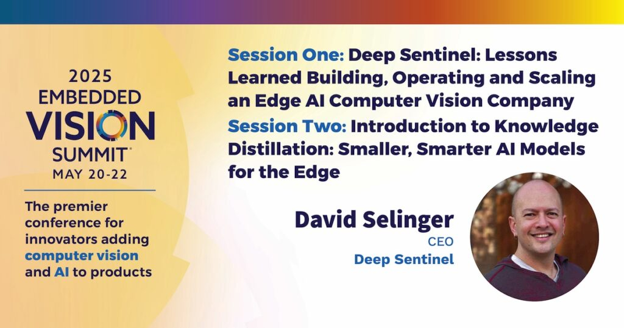
Deep Sentinel: Lessons Learned Building, Operating and Scaling an Edge AI Computer Vision Company Deep Sentinel’s edge AI security cameras stop some 45,000 crimes per year. Unlike most security camera systems, they don’t just record video for later playback: they use edge AI, vision and humans in the loop to detect crimes in progress. And then they react—quickly!—to stop the bad guys. In this humorous and fast-paced talk, David Selinger, CEO of Deep Sentinel, shares some hard lessons he learned in his journey taking Deep Sentinel’s AI cameras from idea to product. From the perspective of a software guy trying to build hardware, you’ll hear about pitfalls ranging from the challenges of low-volume manufacturing to the joys of hardware vendor software support. If you’re bringing a vision product to market, you can’t afford to miss this presentation—and if you’re a hardware, software or services supplier, come learn what you can do to make your customers’ lives easier. |
 |
|
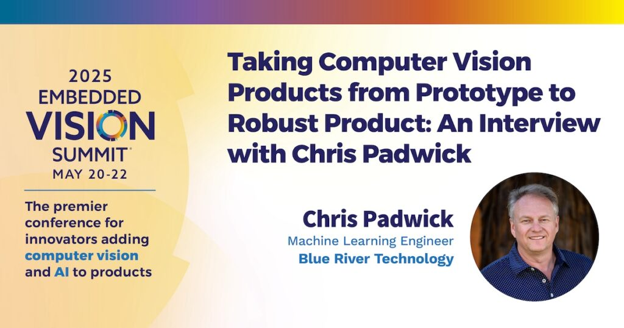
Taking Computer Vision Products from Prototype to Robust Product When developing computer vision-based products, getting from a proof of concept to a robust product ready for deployment can be a massive undertaking. The most vexing challenges in this process often relate to the “long-tail problem,” which arises when datasets have highly imbalanced distributions of classes. This candid conversation between Chris Padwick, Machine Learning Engineer at Blue River Technology, and Mark Jamtgaard, Director of Technology at RetailNext, focuses on the realities of delivering reliable computer vision products to market, delves into lessons learned from Padwick’s years of experience developing automated farming equipment for deployment at scale and explores practical strategies for data curation, data labeling and model testing approaches. Padwick and Jamtgaard also discuss approaches for tackling challenges such as object class confusion and correlated training data. |
SCALING THE TECHNICAL STACK |
 |
|
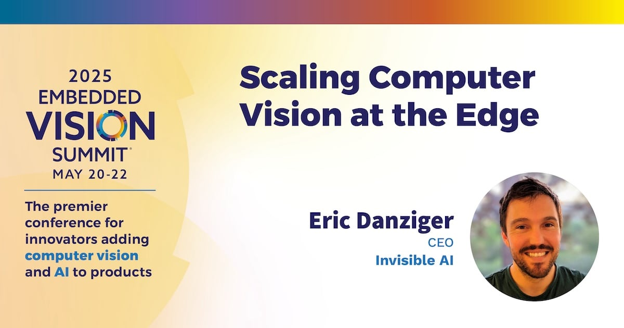
Scaling Computer Vision at the Edge In this presentation, Eric Danziger, CEO of Invisible AI, introduces a comprehensive framework for scaling computer vision systems across three critical dimensions: capability evolution, infrastructure decisions and deployment scaling. Today’s leading-edge vision systems leverage scalable models that, when utilized through prompting, enable advanced capabilities without the resource demands of general-purpose AI vision. However, scaling these systems faces significant edge computing challenges, where limited compute power and networking capabilities restrict the number of camera streams that can be processed, leading to increased costs and complexity. Danziger presents a structured approach to navigating these trade-offs, showcasing automation tools and deployment strategies that help engineering teams with limited resources maximize capabilities while making optimal decisions between edge and cloud processing architectures. |
 |
|
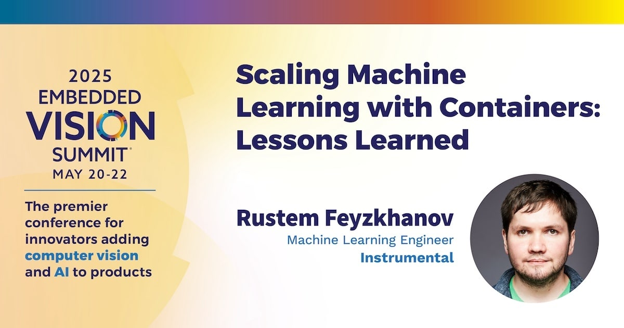
Scaling Machine Learning with Containers: Lessons Learned In the dynamic world of machine learning, efficiently scaling solutions from research to production is crucial. In this presentation, Rustem Feyzkhanov, Machine Learning Engineer at Instrumental, explores the nuances of scaling machine learning pipelines, emphasizing the role of containerization in improving reproducibility, portability and scalability. Key topics include building efficient training pipelines, monitoring models in production and optimizing costs while handling peak loads. You’ll learn practical strategies for bridging the gap between research and production, ensuring consistent performance and rapid iteration cycles. Tailored for professionals, this presentation delivers actionable insights to enhance the scalability and robustness of ML systems across diverse applications. |
UPCOMING INDUSTRY EVENTS |
|
Cleaning the Oceans with Edge AI: The Ocean Cleanup’s Smart Camera Transformation – The Ocean Cleanup Webinar: March 3, 2026, 9:00 am PT Why your Next AI Accelerator Should Be an FPGA – Efinix Webinar: March 17, 2026, 9:00 am PT Embedded Vision Summit: May 11-13, 2026, Santa Clara, California |
FEATURED NEWS |
|
NAMUGA has launched the Stella-2 next-generation 3D LiDAR sensor Google has added “Agentic Vision” to Gemini 3 Flash Yole Group discusses why DRAM prices keep rising in the age of AI Microchip has expanded the PolarFire FPGA Smart Embedded Video ecosystem with new SDI IP cores and a quad CoaXPress™ bridge kit NanoXplore and STMicroelectronics have delivered a european FPGA for space missions |