
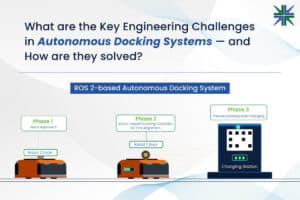
What are the Key Engineering Challenges in Autonomous Docking Systems and How are they Solved? (Part 2)
This blog post was originally published at e-con Systems’ website. It is reprinted here with the permission of e-con Systems. Designing an ROS 2-based autonomous docking system is only half the story. Deploying it in the real world is another matter entirely. Since real industrial environments don’t cooperate with textbook assumptions, understanding these challenges will help

Seeing the Invisible: How Advanced AFEs Give Robots True Self Awareness
This blog post was originally published at NXP Semiconductors’ website. It is reprinted here with the permission of NXP Semiconductors. If cameras, LiDAR and IMUs are a robot’s eyes and inner ear, then precision analog measurement is its “sense of self”, the quiet awareness of currents, strains and temperatures that tell you how the machine

Yole Group Forecasts Automotive Semiconductor Market Will Double to $160 Billion by 2031
Yole Group has released Automotive Semiconductor Trends 2026, a new market report examining how electrification, advanced driver-assistance systems, centralized computing and software-defined vehicle architectures are reshaping the automotive semiconductor industry. Yole forecasts that the market will more than double from $77 billion in 2025 to $160 billion in 2031, representing a compound annual growth rate
What Quality Managers Get Wrong Before a Single Camera is Installed
This blog post was originally published at Lincode’s website. It is reprinted here with the permission of Lincode. The pilot looked great. Detection rates were strong, the demo impressed leadership, and the vendor was confident. Then it hit real production. Variable lighting, inconsistent line speeds, legacy equipment that wouldn’t talk to modern software, and operators who

Reinventing Belt Monitoring: How AI Detects Damage Before Failure
This blog post was originally published at Renesas’ website. It is reprinted here with the permission of Renesas. In industrial motor-driven systems, belts play a critical role in enabling the smooth and efficient transfer of mechanical power between rotating elements. These components connect two shafts, one driven by a motor and the other powered through a

How Robot Fleets achieve Full Mission Autonomy – From ROS 2 Autonomous Docking to Self-Charging (Part 1)
This blog post was originally published at e-con Systems’ website. It is reprinted here with the permission of e-con Systems. True operational autonomy requires more than mapping since robots have stringent expectations to meet. They must manage their own energy, return to charge when needed, and resume their missions without human intervention. e-con Systems has developed

Upcoming Webinar on Intel AI Super Builder and OpenVINO Model Server
On August 26, 2026 at 10:00 am PT (1:00 pm ET), Intel will present the webinar “Multi-Agent & Hybrid AI with Intel® AI Super Builder and OpenVINO™ Model Server.” Here’s the description, from the event registration page: In this session, we’ll walk through a practical approach to building AI applications using Intel® AI Super Builder,

BrainChip AKD1500 Now Available in Compact M.2 Form Factor, Enabling Edge AI in Industrial and Commercial Designs
Lower-cost, lower-power edge AI accelerator gives designers a plug-and-play path to upgrade legacy systems to Akida LAGUNA HILLS, Calif. – July 28, 2026 — BrainChip Holdings Ltd. (ASX: BRN, OTCQX: BRCHF, ADR: BCHPY), a global leader in ultra-low power, fully digital, event-based neuromorphic AI, today announced that its AKD1500 chip based on the Akida™ neuromorphic

Free Webinar on Automotive Perception in the Physical AI Era
On September 29, 2026 at 9 am PT (noon ET), Pierrick Boulay, Principal Analyst, Automotive Semiconductors, and Anas Chalak, Technology & Market Analyst, Imaging at Yole Group, will present the free hour webinar “Automotive Perception in the Physical AI Era: Imaging, Sensors and Computing,” organized by the Edge AI and Vision Alliance. Here’s the description,
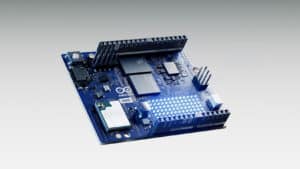
The Arduino UNO Q Board: Unpack the Dual-Brain Power for Next-Gen Edge AI
This blog post was originally published at Qualcomm’s website. It is reprinted here with the permission of Qualcomm. Get ready to reimagine what’s possible with Arduino! The new Arduino® UNO Q is shaking things up by bringing a powerful, dual-brain approach to your IoT development. This board is an approachable starting point for beginner robotics, sensor integration, local