
NXP Tech Days Comes to Silicon Valley
NXP Semiconductors will host “NXP Tech Days,” on August 18, 2026, from 9:00 am to 6:00 pm PDT in Santa Clara, California. The event will feature hands-on workshops, expert-led sessions, and real-world insights across embedded systems, edge AI, connectivity, and security. From the event page: The Future, Engineered During the general session, discover how NXP

Mistral’s 8B Robostral Navigate Steers Robots Using a Single RGB Camera
Mistral AI has introduced Robostral Navigate, an 8-billion-parameter embodied navigation model designed to move robots through unfamiliar environments using natural-language instructions and images from a single RGB camera. Unlike many vision-language navigation systems, it does not require LiDAR, depth sensing or a panoramic multi-camera rig. On the R2R-CE validation-unseen benchmark, Mistral reports a 76.6% success
NVIDIA Introduces New Jetson Thor Computers to Advance Mainstream Robotics and Edge AI
New NVIDIA Blackwell-powered T3000 and T2000 modules, paired with new NVIDIA Jetson software memory optimization and agent skills, help partners and customers move advanced robotics, visual AI and edge workloads onto compact, power-efficient systems. This news blog post was originally published at NVIDIA’s website. It is reprinted here with the permission of NVIDIA. General-purpose
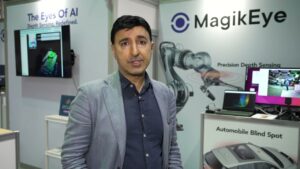
The Eyes of Physical AI: Market Opportunities for MagikEye’s ILT Technology
Feisal Afzal discusses the growing market opportunities for MagikEye’s Invertible Light™ Technology across robotics, smart appliances, automotive systems, and emerging Physical AI platforms. The conversation explores how efficient depth perception can enable safer, smarter, and more capable machines operating at the edge. With increasing demand for spatial intelligence in the physical world, ILT is positioned
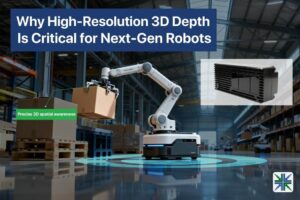
Why High-Resolution 3D Depth Is Critical for Next-Generation Robots
This blog post was originally published at e-con Systems’ website. It is reprinted here with the permission of e-con Systems. When discussing 3D depth cameras, “high-resolution” refers to a sensor’s ability to capture a dense, detailed map of distance measurements. Specifically, it means the sensor provides more individual data points, or pixels, across its field of

Beyond the Bench: The Hard Truth About Robotics Automation in Logistics with Pickle Robotics
This video was originally published by Peridio. It is reprinted here with the permission of Peridio. In this episode of Beyond the Bench from Peridio, Bill Brock sits down with Ari Eisenstein, co-founder and CTO of Pickle Robotics. They discuss the evolution of robotics and AI, focusing on Pickle’s innovative approach to logistics automation. Ari
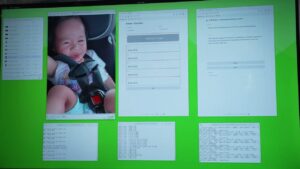
Bolom Sound Classification on Cadence Tensilica HiFi 5
Mauricio Greene of Bolom demonstrates real-time Sound Classification running on the Cadence Tensilica HiFi 5 DSP at the Embedded Vision Summit. Bolom Acoustic Intelligence edge models identify hundreds of distinct sound events and soundscape scenes – such as sirens, alarms, horns, traffic and more, fully on-device and without relying on the cloud. The Tensilica HiFi
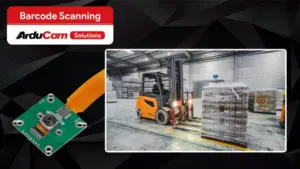
Optimizing Warehousing Efficiency: Arducam’s Custom Barcode Scanning Solution for Smart Forklifts
This blog post was originally published at Arducam’s website. It is reprinted here with the permission of Arducam. In the rapid evolution of smart warehousing, the forklift has transformed from a simple lifting machine into a sophisticated mobile data hub. For an Automated Identification Solutions provider, the challenge isn’t just about “taking a picture” of a barcode; it’s

AI Goes Horizontal—Analog Goes Deep
This blog post was originally published at Renesas’ website. It is reprinted here with the permission of Renesas. An AI-driven gadget that acts on a drifting signal doesn’t know it’s wrong. It just acts—confidently, precisely, and in the wrong direction. Confidence without accuracy isn’t intelligence. It’s a liability. The gap between what a system is told
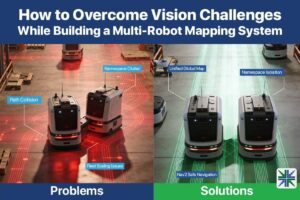
How to Overcome Vision Challenges While Building a Multi-Robot Mapping System (Part 2)
This blog post was originally published at e-con Systems’ website. It is reprinted here with the permission of e-con Systems. In part 1 of this series, you explored why multi-robot autonomous mapping is becoming essential for large-scale facilities and what the core components of a modern multi-robot mapping system are. But knowing what a system should

Engineering Intelligence at the Physical Edge
As AI moves into vehicles, appliances and industrial systems, the next challenge is scaling physical intelligence safely, reliably and in real-world conditions This article was originally published at HCLTech’s website. It is reprinted here with the permission of HCL Tech. Key takeaways Physical AI is reaching an inflection point as intelligence moves into real-world systems
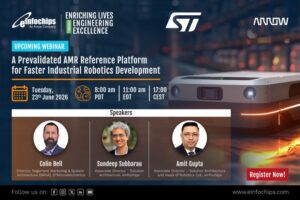
Upcoming Webinar to Introduce Industrial Robotics Reference Platform
On June 23, 2026, at 8:00 am PDT (11:00 am EDT / 17:00 CEST) STMicroelectronics, eInfochips and Arrow will deliver a webinar “A Prevalidated AMR Reference Platform for Faster Industrial Robotics Development” From the event page: STMicroelectronics and Arrow Electronics are introducing a new industrial autonomous mobile robot (AMR) reference platform built to help teams

Upcoming Webinar on Real-Time Perception and the Role of FPGAs
On July 25, 2026, at 1:00 pm PDT (4:00 pm EDT) Lattice Semiconductor will deliver a webinar “The Future of Robotics: Real-Time Perception, Edge AI, & the Role of FPGAs” From the event page: As robotics systems evolve from traditional automation to intelligent, perception-driven platforms, new architectural considerations are emerging around real-time sensing, data processing,

“Democratizing Physical AI: Arduino’s Open Door to Qualcomm’s Platform,” a Presentation from Qualcomm Technologies, Inc.
Olivier Bloch, Director of Developer Relations at Qualcomm Technologies, Inc. presents “Democratizing Physical AI: Arduino’s Open Door to Qualcomm’s Platform” at the May 2026 Embedded Vision Summit. Scaling physical AI breaks at production: prototypes work, then teams rewrite everything for incompatible SDKs, models and control stacks. The core issue is… “Democratizing Physical AI: Arduino’s Open
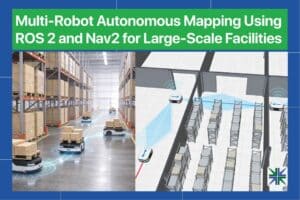
Why Multi-Robot Autonomous Mapping Is Becoming Essential for Large-Scale Facilities (Part 1)
This blog post was originally published at e-con Systems’ website. It is reprinted here with the permission of e-con Systems. For years, facility digitization has relied on a single, expensive robot slowly traversing every corridor of a warehouse, laboratory, or industrial plant. While effective, this approach is linear, which clashes with the fact that facilities are
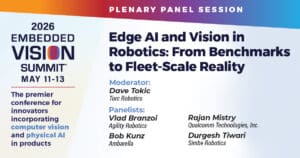
“Edge AI and Vision in Robotics: From Benchmarks to Fleet-Scale Reality,” an Expert Panel
Dave Tokic, Vice President of Corporate Development at Torc Robotics moderates the “Edge AI and Vision in Robotics: From Benchmarks to Fleet-Scale Reality” expert panel at the May 2026 Embedded Vision Summit. Other panelists include Vlad Branzoi, Perception Sensors Team Lead and Senior Staff Engineer at Agility Robotics, Bob Kunz,… “Edge AI and Vision in
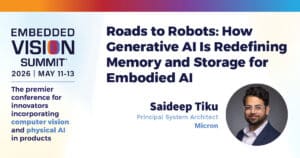
“Roads to Robots: How Generative AI Is Redefining Memory and Storage for Embodied AI,” a Presentation from Micron
Saideep Tiku, Principal System Architect at Micron presents “Roads to Robots: How Generative AI Is Redefining Memory and Storage for Embodied AI” at the May 2026 Embedded Vision Summit. Generative AI has accelerated the automation of complex digital tasks, and now multimodal perception and reasoning make embodied AI the next… “Roads to Robots: How Generative
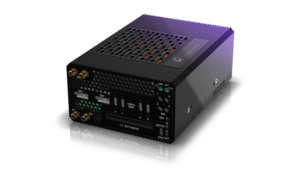
Introducing the Qualcomm Dragonwing IQ10 RRD: A full-stack robotics reference design
A robotics reference design that brings integrated hardware, software and AI tools into one deployment-ready system Key Takeaways: The Dragonwing IQ10 Robotics Reference Design (RRD) aims to help teams move from prototype to production by combining compute, sensing, networking and software in a single deployment-ready system. The platform is designed to deliver up to