

LETTER FROM THE EDITOR |
 |
|
Dear Colleague, This month’s Embedded Vision Summit was a resounding success, with more than a thousand attendees learning from nearly a hundred presenters and hundreds of demos, as well as making valuable connections. 2026 Embedded Vision Summit presentation videos and slide decks will become available on the Edge AI and Vision Alliance website starting in the coming weeks. In case you haven’t yet heard, the 2027 Embedded Vision Summit will be a distinct part of SPIE Photonics West in San Francisco. See you at the 2027 Summit, February 2-4! Erik Peters |
BUILDING AND DEPLOYING REAL-WORLD ROBOTS |
BETTER VISUAL SIGNALS FROM SENSORS |
 |
|
Face Super Resolution for Better Video Experiences Visidon explains how face super-resolution can improve video collaboration by making participants’ faces clearer, more consistent and more natural-looking, even when people are seated at different distances from a shared room camera. In wide-angle meeting-room setups, people farther from the camera occupy fewer pixels, which reduces visible facial detail and makes remote participation feel less balanced. The article introduces pixels per face width as a practical way to understand this problem: as distance increases, the number of pixels representing a face falls, and subtle expressions become harder to see. Rather than simply enlarging the image using conventional interpolation, Visidon’s approach applies a face-specific super-resolution model trained to reconstruct human facial detail. The result is sharper, more lifelike face imagery and more consistent quality across all meeting participants. |
 |
|
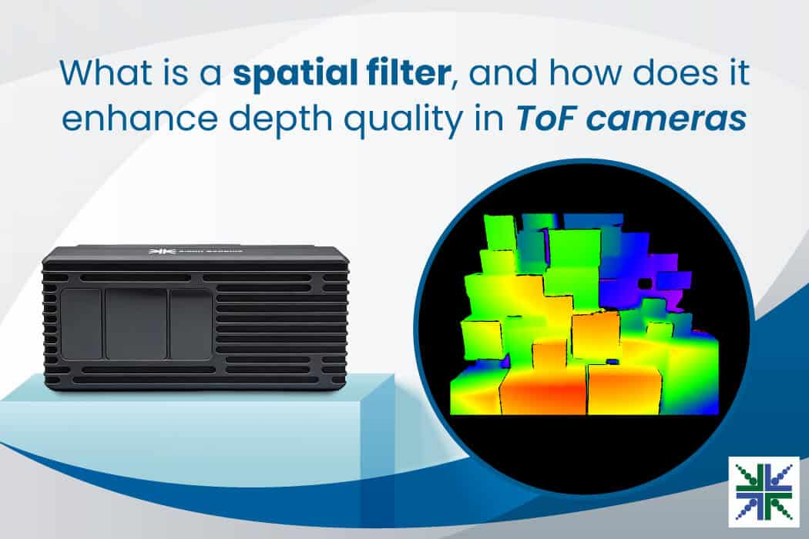
What is a Spatial Filter, and How Does it Enhance Depth Quality in ToF Cameras? e-con Systems provides a practical explanation of spatial filtering for time-of-flight cameras, focusing on how filtering improves the quality of depth maps used in 3D vision systems. ToF cameras estimate distance by measuring the phase shift between emitted near-infrared light and its reflection, but raw depth data often includes noise caused by sensor limitations, reflectivity differences and ambient light. These artifacts can appear as jitter, blurred edges or scattered point-cloud errors. The article walks through three common filter types: Gaussian filters for smoothing noisy surfaces, bilateral filters for reducing noise while preserving object boundaries and median filters for suppressing outlier pixels caused by reflections or transient artifacts. It also highlights the trade-offs developers must manage among smoothness, edge preservation and computational cost. For applications such as object dimensioning, industrial inspection, segmentation and volumetric analysis, spatial filtering can make depth data more stable, coherent and usable by downstream vision algorithms. |
BUILDING AUTONOMOUS EDGE INTELLIGENT SYSTEMS |
 |
|
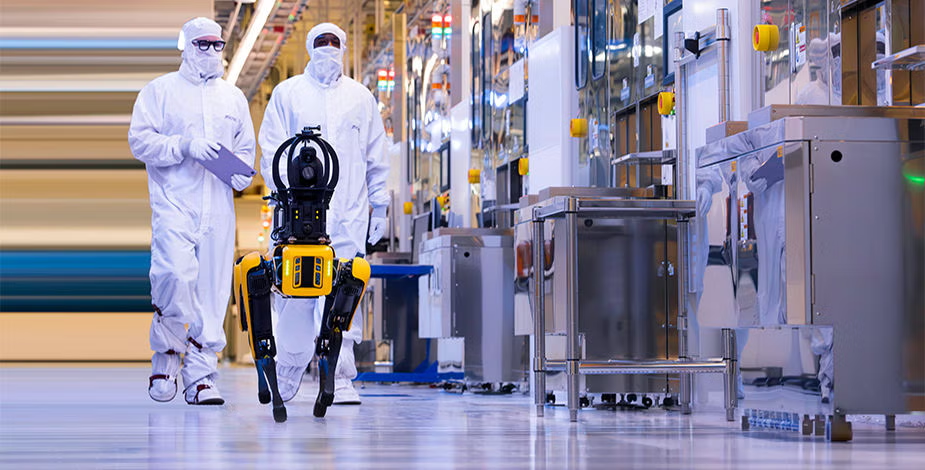
Everything Is Going to Be Driven by Algorithms Ambarella argues that edge AI is entering a new phase: moving beyond local perception toward on-device reasoning, planning and action. For years, connected devices largely served as passive sensors, collecting data and sending it to the cloud for processing. That architecture becomes less practical as cameras, radars, lidars and other sensors generate more data than networks can economically or reliably move, especially when decisions must happen in milliseconds. The article describes a shift from stateless inference pipelines to agentic workflows that maintain context, use tools, verify results and take action. It also presents a distributed architecture in which far-edge devices handle real-time perception and control, near-edge systems coordinate across devices and cloud systems manage heavier analytics and model lifecycle tasks. Vision-language models play an important role as flexible orchestrators, interpreting visual context and routing tasks to specialized models. The article frames agentic edge AI not just as a machine-learning challenge, but as a systems-engineering challenge. |
 |
|
The Rise of Smarter Robots and Why Memory Is Becoming Their Superpower Micron looks at the growing hardware demands behind the next generation of intelligent robots. As robots become more autonomous, adaptive and AI-driven, their memory and storage requirements increase sharply. The article surveys several categories of robots—including factory robots and cobots, autonomous mobile robots, service robots and humanoids—and explains how each places different demands on DRAM, NAND and storage capacity. Modern robots increasingly function as edge computers with bodies: they must process sensor data, run AI models, make real-time decisions, log data continuously and operate reliably in dynamic and often harsh environments. Autonomous mobile robots need fast memory for mapping, navigation and sensor fusion, while humanoids push requirements further with multi-camera perception, tactile sensing, real-time interaction and complex actuation. The central point is that autonomy depends not only on processors and algorithms, but also on high-bandwidth, high-capacity and durable memory and storage. For robotics developers, memory architecture is becoming a key enabler of scalable, dependable AI-driven systems. |
UPCOMING INDUSTRY EVENTS |
|
From Annotation to Deployment: Building an Object Detection Pipeline with Geti, YOLO26, and OpenVINO – Intel Webinar: May 27, 10:00 am PT Embedded Computing Summit Global Technical Tour – Hosted by AMD: June 16, London, UK & June 18, Eindhoven, Netherlands Physical AI Superconnect 2026: M.AX: A New Era of Manufacturing AI Transformation, –Hosted by KOTRA Silicon Valley: June 24, Mountain View, California Embedded Vision Summit: February 2-4, 2027, San Francisco, California |
FEATURED NEWS |
|
Synopsys has launched five Synopsys.ai Copilot assistants to deliver 2–5× faster chip design productivity Renesas has acquired Irida Labs to expand vision AI software capabilities and system-level vision Solutions Synaptics has released the Astra SR80 series of MCUs for always-on edge AI audio Image Quality Labs has announced the Matterhorn Sony IMX462 camera adapter board for Toradex Verdin platforms Synetic Debuts LYNX Computer Vision SDK at the 2026 Embedded Vision Summit FotoNation has completed a pre-A round of funding and announced a strategic collaboration with SEMIFIVE for to develop its TriSilica perceptual AI chip family |
EDGE AI AND VISION PRODUCT OF THE YEAR WINNER SHOWCASE |
.png?width=1120&upscale=true&name=Intel%20Core%20Ultra%20Series%202%20processors%20(Best%20Edge%20AI%20Processor).png) |
|
Intel Core Ultra Series 2 processors (Best Edge AI Processor) Intel’s Core Ultra Series 2 processors have been awarded the 2026 Edge AI and Vision Product of the Year in the Edge AI Processors category. Codenamed Arrow Lake-H, the processors deliver a major leap in AI, graphics, and system flexibility compared with Series 1 (Meteor Lake-H). They integrate up to 16 cores, a next-generation Intel Arc GPU with up to 8 Xe cores, and an upgraded NPU (Intel AI Boost), reaching up to 99 total platform TOPS—nearly 3× higher than Series 1. Performance gains are tangible: the Intel Core Ultra 9 285H achieves up to 2.2× higher AI Computer Vision throughput (Procyon), 3.3× faster Llama 3 8B inference, and 2.3× faster Stable Diffusion 1.5 generation compared with the Ultra 9 185H (Series 1) processor. Series 2 also adds Xe Matrix Extensions (XMX), hardware-accelerated AV1 encode, and support for four 4K or two 8K displays with Pipelock synchronization, eliminating the need for discrete GPUs in demanding visual workloads. A widened 12–65 W TDP range, PCIe 5.0, DDR5/LPDDR5x-8400 memory, Thunderbolt 4, and integrated Wi-Fi 7 enable scalable, high-bandwidth edge designs. Combined with OpenVINO and Intel Open Edge Platform support, Series 2 empowers generative AI, computer vision, and multimedia inference—offering unmatched AI efficiency and responsiveness at the edge.Please see here for more information on Intel’s Core Ultra Series 2 processors. The Edge AI and Vision Product of the Year Awards celebrate the innovation of the industry’s leading companies that are developing and enabling the next generation of edge AI and computer vision products. Winning a Product of the Year award recognizes a company’s leadership in edge AI and computer vision as evaluated by independent industry experts |