
LETTER FROM THE EDITOR |
 |
|
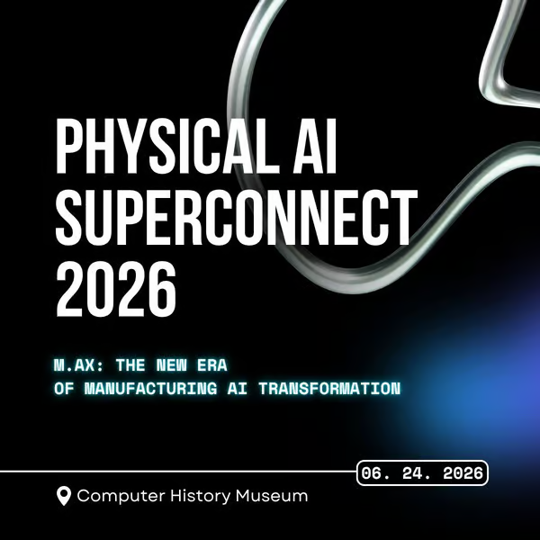
Dear Colleague, This week’s featured presentations focus on practical ways to accelerate edge AI development—from choosing programmable FPGA-based accelerators and designing efficient computer vision systems for tightly constrained far-edge devices to using AI coding agents safely and effectively in real embedded development workflows. Efinix and Lattice Semiconductor examine hardware and model-design strategies for meeting demanding cost, power, latency, memory and I/O constraints. Ambarella and Boston.AI explore how AI-assisted software development can help teams build trustworthy edge systems and navigate major platform transitions such as OpenCV 5. But before we get to those topics, I want to alert you to an interesting event. Alliance partner KOTRA invites you to explore cutting-edge innovations at Physical AI Superconnect 2026 on June 24 in Mountain View, California. Engage with nearly 40 Korean companies showcasing component- and system-level advancements in manufacturing and service robots, autonomous driving and more. It’s a great opportunity to connect with innovative companies and new technologies. Learn more and register here. Erik Peters
|
BUILDING AND DEPLOYING REAL-WORLD ROBOTS |
CODING AGENTS AT THE EDGE |
 |
|
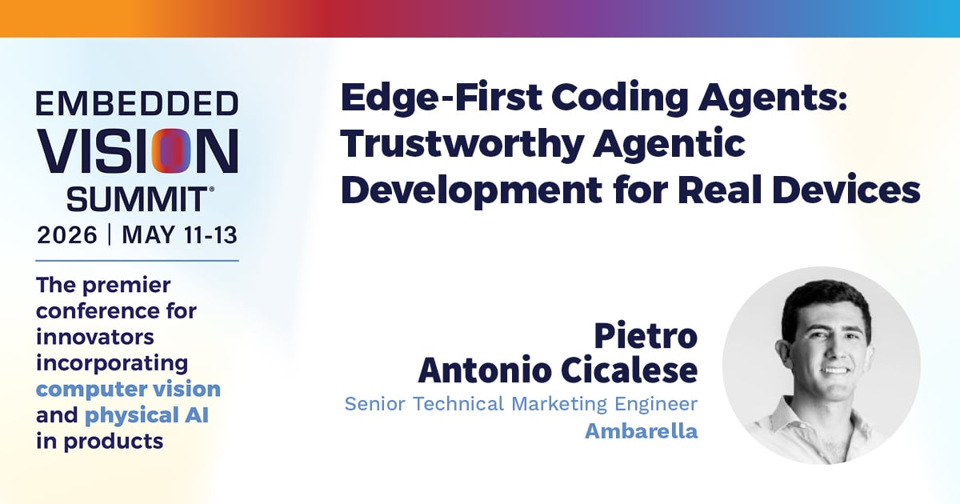
Edge-First Coding Agents: Trustworthy Agentic Development for Real Devices Coding agents are usually built as cloud-first abstractions. But for developing trustworthy, production-ready edge systems, coding agents should be designed from the edge outward—where privacy, bandwidth and real-time requirements are real constraints. In this talk, Pietro Antonio Cicalese, Senior Technical Marketing Engineer at Ambarella, shows how Ambarella is reimagining coding agents for heterogeneous edge AI/computer vision development: separating reasoning from execution, routing capabilities explicitly, checking runtime constraints, validating actions against observed device behavior and providing inspectable evidence and fallbacks. He then makes these ideas concrete with Ambarella’s Cooper Developer Platform, which unifies hardware and software bring-up, optimized models and multimodal pipelines and low-code/no-code agentic blueprints that turn high-level intent into deployable edge workflows. Viewers will leave with a practical model for edge-native, governed agentic development and a road map for building physical AI that can ship. |
 |
|
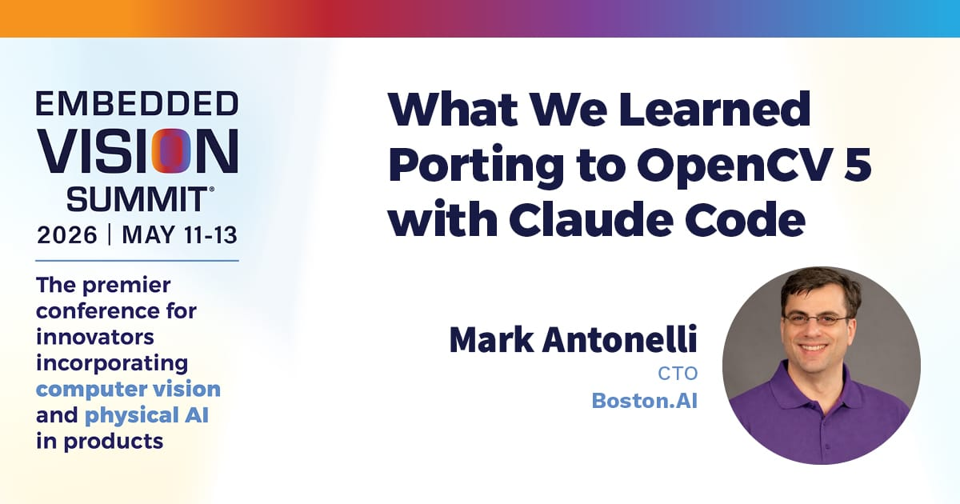
What We Learned Porting to OpenCV 5 with Claude Code OpenCV 5 introduces significant architectural changes to improve vision performance and better utilize modern hardware. In addition to support for new features like vision-language models, there are paradigm shifts such as a revamped Graph API (G-API), universal intrinsics and the removal of C language support. Engineering teams need to take advantage of these changes without missing opportunities for improvement or going down the wrong path. Enter generative AI—it can be either your best friend or your worst enemy when rewriting code. In this talk, Mark Antonelli, CTO at Boston.AI, explores a pragmatic workflow using Claude Code to guide the migration process. He moves beyond basic code generation to focus on using generative AI as a learning and architectural tool. He also explains how to provide the right context and environment to an LLM so it understands OpenCV 5’s specific changes, rather than falling back on legacy 4.x knowledge. He shares practical prompting techniques to encourage modern “G-API thinking” instead of repeating old patterns. In addition, he shows how to handle common pitfalls, such as when an LLM suggests ignoring compiler warnings, and how to use LLMs to quickly demystify complex new OpenCV features like multimodal inputs. Viewers will leave with a realistic perspective on where LLM coding assistants excel in the migration process and where human oversight is critical. |
FPGAS FOR EDGE AI ACCELERATION |
 |
|
Why Your Next AI Accelerator Should Be an FPGA Edge AI system developers often assume that AI workloads require a GPU or NPU. But when cost, latency, complex I/O or tight power budgets dominate, FPGAs offer compelling advantages. In this talk Mark Oliver, VP of Marketing and Business Development at Efinix, explores how FPGAs serve not just as compute blocks, but as system integration and acceleration platforms that can combine tailored sensor I/O, signal processing, pre/post-processing and neural inference on one device. He also shows how to map AI models onto FPGAs without doing custom hardware design, using two practical on-ramps: (1) a software-first flow that generates custom instructions callable from C, and (2) a turnkey CNN acceleration block. Using representative embedded vision workloads, he shows apples-to-apples benchmarks. Viewers will leave with a decision checklist and concrete “first experiment” plan. |
 |
|
Efficient Computer Vision at the Far Edge: Design and Training Under Constraints This session explores practical strategies for deploying computer vision AI on far-edge devices under strict resource constraints. While highlighting FPGA-specific strengths, such as customizable dataflows, fine-grained quantization control and efficient near-sensor processing, Nicolas Widynski (AI Fellow at Lattice Semiconductor) also covers techniques applicable across edge platforms. He addresses challenges like limited model capacity and memory, and discusses pipeline design, quantization methods and hardware-aware training workflows that preserve gradient flow and feature quality—enabling robust, real-time AI performance even in highly constrained environments. |
UPCOMING INDUSTRY EVENTS |
|
Embedded Computing Summit Global Technical Tour – Hosted by AMD: June 16, London, UK & June 18, Eindhoven, Netherlands Physical AI Superconnect 2026: M.AX: A New Era of Manufacturing AI Transformation, –Hosted by KOTRA Silicon Valley: June 24, Mountain View, California Embedded Vision Summit: February 2-4, 2027, San Francisco, California |
FEATURED NEWS |
|
GlobalFoundries has acquired Synopsys’ ARC Processor IP Solutions Business Axelera AI and Andes Technology have partnered on the “Europa” AI platform with high-performance RISC-V AX65 cores Qualcomm has introduced the Dragonwing IQ10 RRD: a full-stack robotics reference design Yole Group has released its latest market report highlighting ADAS market acceleration towards $66 billion |
EDGE AI AND VISION PRODUCT OF THE YEAR WINNER SHOWCASE |
.png?width=1120&upscale=true&name=Expedera%20Origin%20Evolution%20NPU%20IP%20(Best%20Edge%20AI%20Processor%20IP).png) |
|
Expedera Origin Evolution NPU IP (Best Edge AI Processor IP) Expedera’s Origin Evolution NPU IP has been awarded the 2026 Edge AI and Vision Product of the Year Award in the Edge AI Processors IP category. Origin Evolution is a unique IP, specifically designed for the evolving needs of LLMs and VLMs at the edge while maintaining full compatibility with popular legacy networks like CNNs and RNNs. It includes specific processing blocks (vector, feed forward, attention) which specifically address the unique processing requirements of today’s and tomorrow’s evolving networks. Coupled with the hardware is a co-designed TVM and Relax-based software stack that enables developers to work efficiently as they deploy their networks on the target hardware. Supporting popular frameworks such as HuggingFace, Llama.cpp, PyTorch, Onnx,TensorFlow, TVM, and others, users can deploy their trained models as-is; no retraining or accuracy reductions are required. Origin Evolution NPUs offer deterministic performance, the smallest memory footprint, and are fully scalable. This makes them perfect for edge solutions with little or no DRAM bandwidth or high-performance applications such as autonomous driving. ASIL-B readiness-certified, Expedera offers the ideal solution for engineers looking for a single NPU architecture that easily runs LLM, CNN, RNN, and other network types while maintaining optimal processing performance, power, and area. Please see here for more information on Expedera’s Origin Evolution NPU IP. The Edge AI and Vision Product of the Year Awards celebrate the innovation of the industry’s leading companies that are developing and enabling the next generation of edge AI and computer vision products. Winning a Product of the Year award recognizes a company’s leadership in edge AI and computer vision as evaluated by independent industry experts. |