
LETTER FROM THE EDITOR |
 |
|
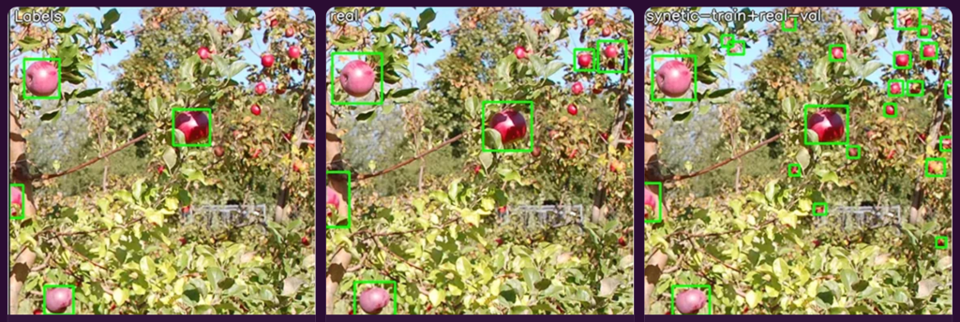
Dear Colleague, This week we’re highlighting practical ways engineering teams are tackling some of the hardest problems in deploying edge AI and vision systems: getting models to work reliably in the real world, modernizing vision software for new hardware and model architectures, and scaling physical AI beyond the prototype stage. Also in this issue, we look at why memory is becoming a central bottleneck for edge AI and how robotics developers are moving from benchmarks toward fleet-scale deployment. We also have two upcoming webinars focused on especially timely challenges: using synthetic data to overcome gaps in real-world training sets, and using generative AI to help port computer vision applications to OpenCV 5. On Tuesday, August 11, we’ll present a webinar on synthetic data in collaboration with Synetic AI. Most edge vision deployments fail not because of model architecture, but because real-world training data is structurally incomplete. Sampled data can’t cover combinatorial edge cases, forcing perpetual retraining cycles that break embedded deployment, explainability requirements and silicon viability. In this session, David Scott, Founder and CEO of Synetic AI, will present peer-reviewed results showing synthetic approaches outperforming real-world data by 34%. He’ll explain how physics-based synthetic generation provides deterministic control over geometry, lighting, occlusion, materials and sensors, and he’ll introduce a new class of models that work on first deployment. More info here. |
 |
|
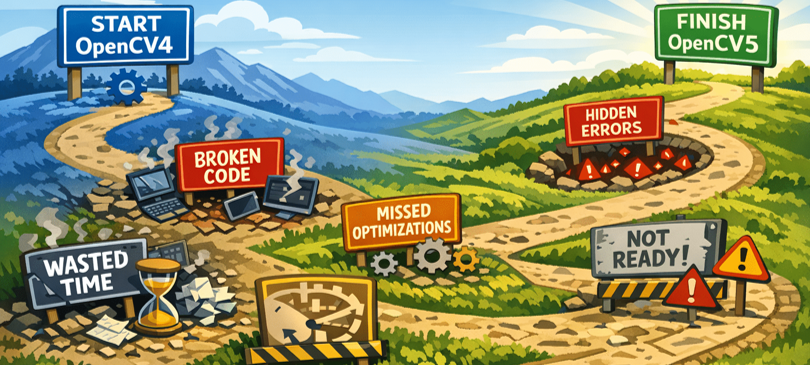
On Thursday, August 13, we’ll present a webinar on using Claude Code to migrate OpenCV code in collaboration with Boston AI. OpenCV 5 introduces significant architectural changes to improve vision performance and better utilize modern hardware. In addition to support for new features like vision-language models, there are paradigm shifts such as a revamped Graph API (G-API), universal intrinsics and the removal of C language support. Engineering teams need to take advantage of these changes without missing opportunities for improvement or going down the wrong path. Enter generative AI. In this talk, Mark Antonelli, CTO of Boston AI, will explore a pragmatic workflow using Claude Code to guide the migration process. He’ll explain how to provide the right context and environment to an LLM so it understands OpenCV 5’s specific changes, rather than falling back on legacy 4.x knowledge. He’ll also share practical prompting techniques to encourage modern “G-API thinking” instead of repeating old patterns. More info here. Without further ado, let’s get to the content. Erik Peters |
BUILDING AND DEPLOYING REAL-WORLD ROBOTS |
MEMORY BECOMES THE AI BOTTLENECK |
 |
|
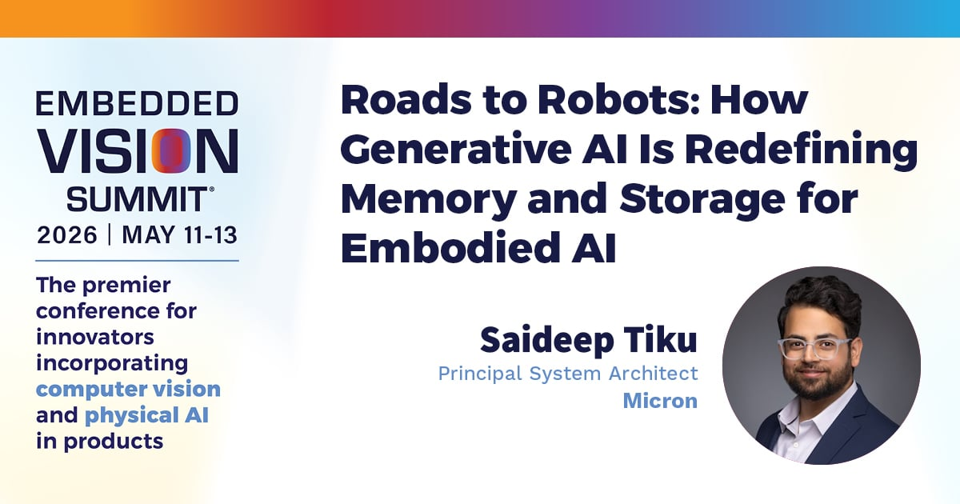
Roads to Robots: How Generative AI Is Redefining Memory and Storage for Embodied AI Generative AI has accelerated the automation of complex digital tasks, and now multimodal perception and reasoning make embodied AI the next frontier. This shift brings adaptive reasoning into the physical realm, enabling natural interaction between humans and intelligent machines, from autonomous vehicles to humanoid robots. While advanced self-driving systems helped pave this path, humanoids introduce a different set of constraints: long-horizon reasoning plus dexterous manipulation must run within a tight power and thermal envelope shared across compute, memory and storage. In this presentation, Saideep Tiku, Principal System Architect at Micron, examines how memory and storage solutions must evolve to meet application-specific requirements, from automotive to humanoid robotics. Attendees will leave with a framework for assessing memory requirements and making design trade-offs as generative reasoning moves into edge devices. |
 |
|
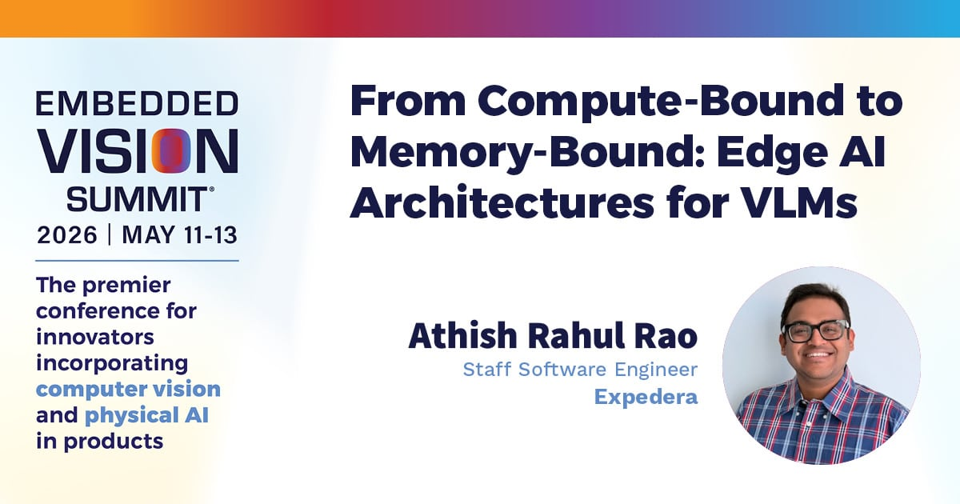
From Compute-Bound to Memory-Bound: Edge AI Architectures for VLMs Today’s edge AI hardware was built for CNNs, but vision-language models (VLMs) have completely different bottlenecks—especially in safety-critical, latency-sensitive applications like in-cabin automotive intelligence. While CNN inference is stateless, parallel and compute-bound, VLMs introduce a large, growing KV cache and a sequential, memory-bound decode phase that quickly overwhelms traditional NPU memory subsystems. In this talk, Athish Rahul Rao, Staff Software Engineer at Expedera, explains why conventional TOPS-focused designs fail for edge VLM workloads and outlines a new approach that combines model optimization, attention-aware cache hierarchies and disaggregated architectures tuned separately for prefill and decode. Viewers will learn how hardware-software co-design and memory-centric architectures can unlock order-of-magnitude gains in latency and efficiency for next-generation embedded vision systems. |
SCALING PHYSICAL AI BEYOND PROTOTYPES |
 |
|
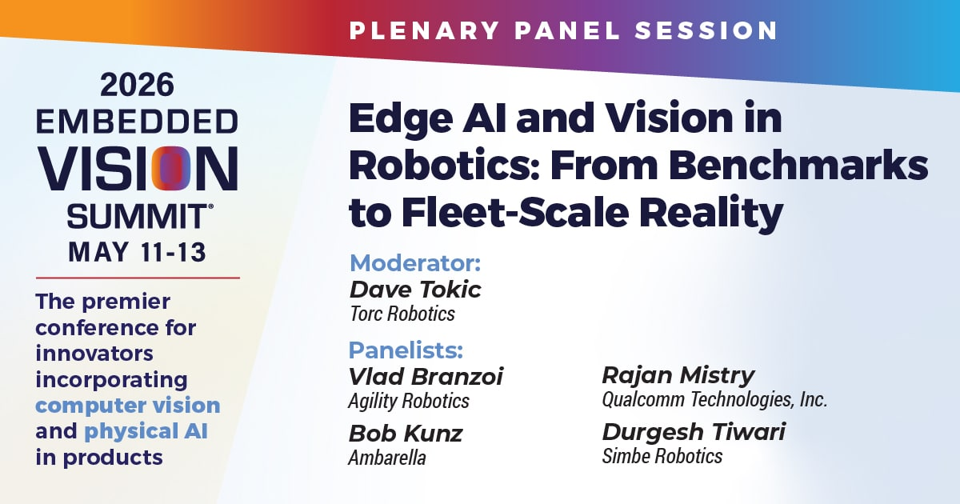
Edge AI and Vision in Robotics: From Benchmarks to Fleet-Scale Reality Edge AI is helping robots see, decide and act in the real world—but the hardest work starts after the demo. In this plenary panel, we unpack where edge AI is creating measurable value today, then dive into the system choices that determine whether a robot ships: vision-only versus multimodal sensing and fusion, the real compute bottlenecks (latency, bandwidth, power, thermals, memory and software) and the trade-offs between modular pipelines and end-to-end learned stacks. We also discuss the data problem—collection, labeling, simulation and continuous improvement—plus the practical role of foundation and vision-language models in embodied systems. Finally, we cover safety and trust around people, why pilots fail to scale, what changes from 10 robots to 1,000, and what breakthroughs are most likely to matter over the next three to five years. Dave Tokic, Vice President of Corporate Development at Torc Robotics moderates this panel. Panelists include Vlad Branzoi, Perception Sensors Team Lead and Senior Staff Engineer at Agility Robotics; Bob Kunz, Chief Architect at Ambarella; Rajan Mistry, Senior Staff Engineer—Developer Advocacy at Qualcomm Technologies, Inc.; and Durgesh Tiwari, VP of Hardware Systems, R&D at Simbe Robotics. |
 |
|
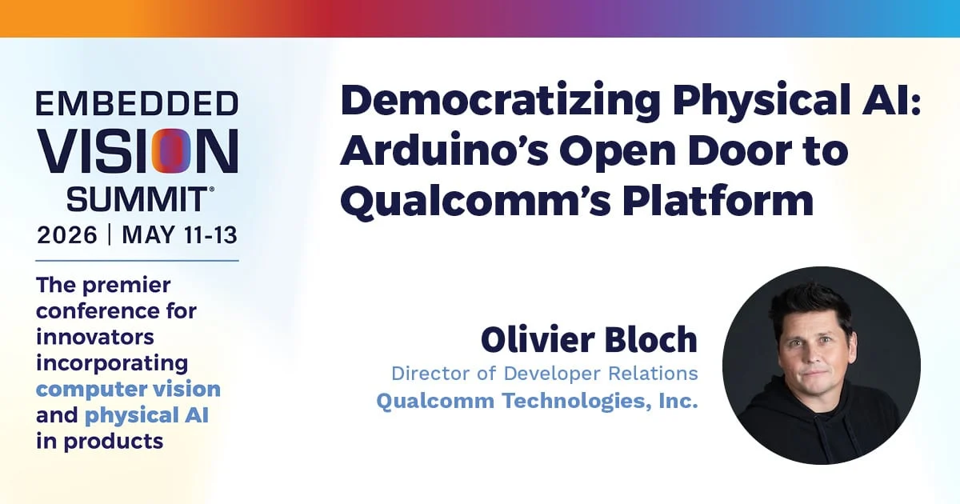
Democratizing Physical AI: Arduino’s Open Door to Qualcomm’s Platform Scaling physical AI breaks at production: prototypes work, then teams rewrite everything for incompatible SDKs, models and control stacks. The core issue is a clash between high-throughput AI and deterministic real‑time control, forcing tradeoffs or fragile handoffs, and turning 90% solutions into months of rework. Arduino VENTUNO Q removes this barrier with a dual‑brain architecture: a Qualcomm Dragonwing IQ‑8275 (up to 40 TOPS) runs AI, while an STM32H5 MCU handles sub‑millisecond real‑time control. Both are coordinated via Arduino App Lab, using the same code, models and tools, from QNN and Edge Impulse to Qualcomm AI Hub, from prototype to production. Olivier Bloch, Director of Developer Relations at Qualcomm Technologies, Inc., demonstrates multi‑camera vision, on‑device gen AI and ROS 2 robotics, showing true prototype‑to‑production continuity without rewrites. |
UPCOMING INDUSTRY EVENTS |
|
Building with Avocado OS on i.MX Applications Processor – Peridio Webinar: June 30, 8:00 am PT Advanced HDR with IMX908, the first ever STARVIS 3 Sensor – RESTAR FRAMOS Webinar: July 21, 10:00 am CEST The Future of Robotics: Real-Time Perception, Edge AI, & the Role of FPGAs – Lattice Semiconductor Webinar: July 25, 1:00 pm PDT Why Edge Vision Models Keep Breaking—and What Complete Training Data Changes – Synetic AI Webinar: August 11, 9:00 am PDT What We Learned Porting to OpenCV 5 with Claude Code – Boston AI Webinar: August 13, 9:00 am PDT Embedded Vision Summit: February 2-4, 2027, San Francisco, California |
FEATURED NEWS |
|
Efinix has launched the Titanium Edge FPGA family to deliver power reduction, system-in-package integration, high-speed MIPI I/O, advanced SEU scrubbing, and post-quantum security Macnica Americas has become an authorized distributor for NAMUGA Vision Connectivity Allegro DVT has added support for the AV2 video codec to its Pulsar Decoder IP SiMa.ai has launched Palette Neat, an agentic environment for physical AI, to cut development time |
EDGE AI AND VISION PRODUCT OF THE YEAR WINNER SHOWCASE |
.png?width=1120&upscale=true&name=ENERZAi%201.58-bit%20Audio%20%26%20Language%20AI%20Suite%20(Best%20Edge%20AI%20Software%20or%20Algorithm).png) |
|
ENERZAi 1.58-bit Audio & Language AI Suite (Best Edge AI Software or Algorithm) ENERZAi’s 1.58-bit Audio & Language AI Suite has been awarded the 2026 Edge AI and Vision Product of the Year Award in the Edge AI Software and Algorithms category. Large audio and language models have made many aspects of our daily lives more convenient, but their size and complexity, often involving billions of parameters and gigabytes of memory, make them impossible to run on edge devices. With limited computing power and memory capacity, most devices depend on cloud inference, resulting in high expenses, latency, and privacy concerns. Most companies now face rapidly rising AI expenses to implement AI features in their products. To solve this, ENERZAi developed an Edge Audio and Language AI Suite that delivers high-performance audio and language AI directly on edge devices with minimal memory and power usage. It enables tasks such as voice command execution, real time translation, and speech to summary analysis entirely on edge devices, allowing customers to eliminate unpredictable and uncontrollable AI expenses. Our innovation combines extreme low-bit quantization, which quantizes large audio and language models to even 1.58-bit precision without accuracy loss, with Optimium, our proprietary inference engine capable of running these extreme low-bit models that most inference engines are unable to support. This combination enables truly high-performance audio and language AI capabilities while reducing AI expenses and unlocking new possibilities for edge intelligence. Please see here for more information on ENERZAi’s 1.58-bit Audio & Language AI Suite. The Edge AI and Vision Product of the Year Awards celebrate the innovation of the industry’s leading companies that are developing and enabling the next generation of edge AI and computer vision products. Winning a Product of the Year award recognizes a company’s leadership in edge AI and computer vision as evaluated by independent industry experts. |