This blog post was originally published at Arducam’s website. It is reprinted here with the permission of Arducam.
Artificial Intelligence is undeniably transforming machine vision. Every week, we witness new neural networks achieving higher accuracy, faster inference times, and more impressive capabilities at the edge.
But when it comes to deploying these AI vision systems in the real world, there is one critical component that is routinely under-engineered and overlooked: the optics.
In embedded and edge vision, the lens is not just an accessory; it is the gatekeeper of your data. In fact, for many real-world applications, optimizing your lens choice can yield a far greater ROI on system performance than endless tweaking of your AI model.
Here is why.
1. The Hard Truth: AI is Subject to “Garbage In, Garbage Out”
Imagine three development teams building three distinct vision systems. All of them use the identical Sony IMX500 Intelligent Vision Sensor, run the exact same pre-trained AI model, and utilize the same on-chip hardware accelerators.
Will they achieve the same inference accuracy? Absolutely not.
Before an AI model can compute a single bounding box or classification score, it must first “see” the world through a lens. What the lens captures dictates the upper limit of the data quality available to the AI.
In data science, the golden rule is “Garbage In, Garbage Out.” If an image suffers from severe optical distortion, poor contrast, or motion blur, even the most sophisticated neural network cannot magically reconstruct the missing data. Field of view (FOV), focal length, aperture, and modulation transfer function (FMT/sharpness) all directly influence the effectiveness of your model.
2. One Sensor, Three Realities: AI Sees What the Lens Allows It to See
To understand why optics dictate AI performance, let’s look at three common edge AI applications utilizing the same IMX500 sensor:
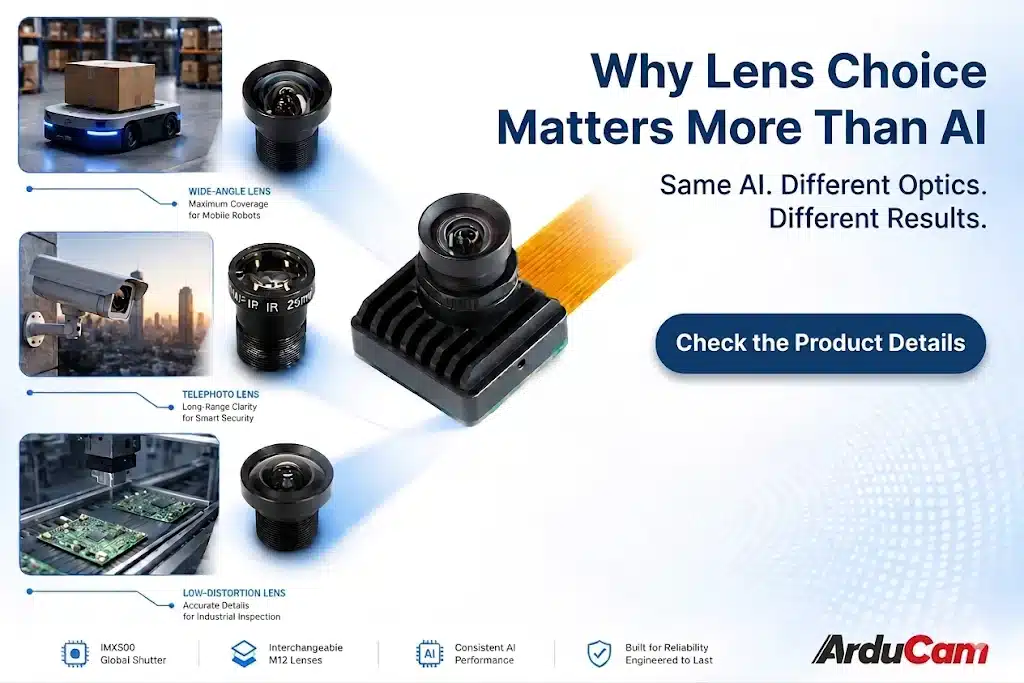
🤖 Robotics & AMR: The Need for Spatial Awareness
Mobile robots and Automated Guided Vehicles (AGVs) operate in dynamic, unpredictable indoor environments. Here, situational awareness is everything.
- The Lens Requirement: A wide-angle lens is non-negotiable. It maximizes the field of view, allowing the AI model to detect peripheral obstacles sooner and map environments efficiently.
- The Risk: Forcing a narrow-FOV lens on a robot restricts its “vision,” leading to navigation blind spots—no matter how fast the IMX500 processes the data.
🛡️ Smart Security & Traffic Monitoring: Maximizing Pixels-on-Target
Long-range surveillance relies heavily on object classification (e.g., distinguishing a person from an animal, or reading a license plate).
- The Lens Requirement: A telephoto lens is essential to narrow the field of view and focus optical resolution on distant targets. This increases the pixels-per-meter (PPM) on the object.
- The Risk: If you use a standard lens, distant objects become tiny pixel clusters. The AI model’s confidence score drops drastically because it lacks the visual detail required for accurate inference.
🏭 Industrial Inspection: Eliminating Geometric Distortion
In factory automation and quality control, precision is measured in millimeters or microns.
- The Lens Requirement: An ultra-low distortion (or telecentric) lens is mandatory.
- The Risk: Standard lenses introduce barrel or pincushion distortion, warping the edges of the image. If the optics warp the product’s shape, the AI will miscalculate dimensions, leading to false positives and failed quality checks.
3. Why Fixed Optics Fail the Deployment Test
Many off-the-shelf AI cameras come equipped with fixed, non-interchangeable lenses. While a fixed lens is convenient for benchtop evaluation, proof-of-concepts, and lab demonstrations, it rarely survives the transition to mass deployment.
Real-world environments don’t conform to a one-size-fits-all hardware specification. Every factory floor, retail ceiling height, and robotic chassis demands a unique optical configuration.
This is precisely why we engineered the Arducam IMX500 MIPI AI Camera Module with an M12 interchangeable lens mount.
Instead of locking developers into a single field of view, the M12 ecosystem allows you to swap optics seamlessly during prototyping and production. Whether your project scales from wide-angle warehouse navigation to tight-focus industrial scanning, you can adapt the hardware to the environment—not the other way around.
4. Beyond the AI Trend: Building Production-Ready Vision Systems
As Edge AI hardware becomes more accessible and standardized, the competitive advantage for hardware OEMs and system integrators is shifting. Building a successful vision product is no longer just about picking the trendiest neural network; it’s about holistic system integration.
A production-ready vision system requires a flawless synergy between:
- The Sensor: Utilizing the Sony IMX500’s on-board processing to reduce host CPU load.
- The Interface: Leveraging high-bandwidth, low-latency MIPI CSI-2 for seamless integration with platforms like Raspberry Pi, Jetson, or custom SoCs.
- The Optics: Matching the precise M12 lens to your specific physical deployment constraints.
The next breakthrough in your computer vision application might not come from a new AI paper or a larger dataset. It might come from simply picking the right lens.
Moving from Demo to Deployment
The Sony IMX500 has opened incredible frontiers for Edge AI by bringing machine learning inference directly onto the sensor. But unlocking its true commercial potential requires seeing the right image in the first place.
With interchangeable M12 optics, a low-latency MIPI interface, and an industrial-grade design, the Arducam IMX500 MIPI AI Camera is built to help you move past lab demonstrations and into robust, real-world deployment.
Because at the end of the day, your AI is only as good as what your lens allows it to see.
🌐 Ready to optimize your next vision system? [Explore the Arducam IMX500 MIPI Camera Datasheet] or [Talk to our Optical Engineers] to find the perfect M12 lens configuration for your project.