
LETTER FROM THE EDITOR |
 |
|
Dear Colleague, This week’s issue highlights an edge AI ecosystem advancing on every front—from new processors, cameras and firmware to software platforms and industry consolidation. We also explore deploying GenAI, implementing voice and multimodal workloads on device, and integrating cameras, radar and computing into automotive physical AI. With both the technology and the industry evolving so quickly, your experience has never been more valuable—and we invite engineers building these systems to help shape the conversation. Here are just a few ways to get involved… The Call for Presentation Proposals for the 2027 Embedded Vision Summit is open. The Summit takes place February 2-4 in San Francisco, and we’re looking for practical, technically substantive proposals on topics including physical AI case studies, efficient edge AI techniques and advances in vision-language models. See the 2027 topics list on the Call for Proposals page for inspiration and submit your proposal by August 14. Another great way to share your expertise is to participate in our annual Computer Vision and Physical AI Developer Survey. Many providers of the building-block technologies that enable computer vision and physical AI products and systems use the results of this annual survey to guide their priorities. We share the survey results at Alliance events, in white papers and presentations throughout the year on the Alliance website, and, of course, with everyone who completes the survey! To show our appreciation, if you are in our target demographic and complete the survey—it takes about 20 minutes—we’ll also provide you with a $250 discount on a full conference pass to the Embedded Vision Summit. Our target demographic for this survey is people who are or have recently been directly involved in an engineering role developing systems or applications using computer vision or other types of physical (sensor-based) AI. Take the Survey. Also, on Tuesday, September 29, we’ll present a webinar on automotive perception in the physical AI era in collaboration with Yole Group. Automotive perception is entering a new phase as vehicles evolve from collections of largely independent sensing and control functions into integrated physical AI systems. Cameras, radar, imaging radar, LiDAR and increasingly powerful computing platforms must now work together to interpret complex environments and enable safer, more capable driver-assistance and automated-driving functions. The webinar will examine these technology changes and how they are reshaping the automotive supply chain as OEMs gain greater control of software and data, semiconductor suppliers provide more complete platforms and Tier-1s strengthen their system-integration capabilities. It will conclude with a market outlook for automotive cameras, sensors and computing content per vehicle. More info here. Without further ado, let’s get to the content. Erik Peters |
BUILDING AND DEPLOYING REAL-WORLD ROBOTS |
FROM AI MODELS TO PRODUCTION PLATFORMS |
 |
|
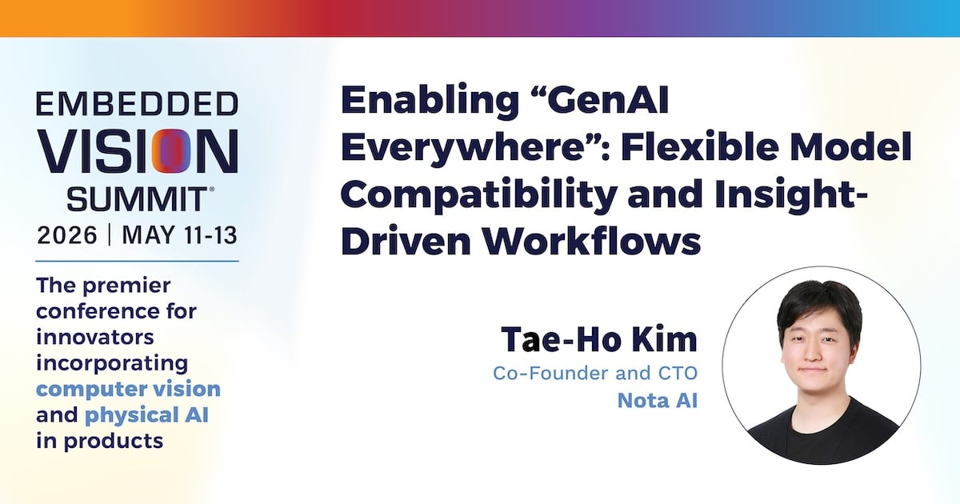
Enabling “GenAI Everywhere”: Flexible Model Compatibility and Insight-Driven Workflows As generative AI models rapidly evolve—with increasingly dynamic transformer architectures and diverse framework variations—the challenge of bringing these models to the edge has grown dramatically. Traditional rule-based optimization pipelines can no longer keep pace with models whose structures shift quickly and whose computation patterns defy rigid assumptions. At the same time, edge hardware has become more fragmented than ever, spanning a wide range of devices that each require distinct optimization strategies to achieve efficient performance. In this session, Tae-Ho Kim, Co-Founder and CTO at Nota AI, reframes what edge AI optimization must look like in the generative AI era. He explores how NetsPresso (Nota AI’s AI model optimization platform) is evolving to support flexible, hardware-aware optimization approaches that adapt to emerging model architectures. He also shows how insight-driven workflows—powered by visual analysis and automated experiment pipelines—help engineers navigate hardware variability, uncover bottlenecks and identify the most effective deployment paths. |
 |
|
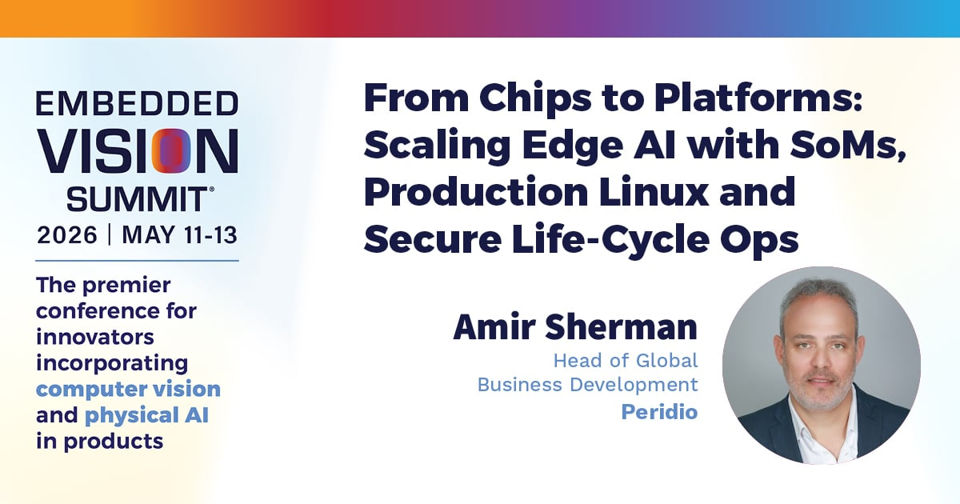
From Chips to Platforms: Scaling Edge AI with SoMs, Production Linux and Secure Life-Cycle Ops Edge AI has moved beyond choosing a single chip or platform. Teams now face a harder question: how to go from prototype to safe, compliant, large-scale deployment—thousands to millions of devices—without drowning in integration work and life-cycle risk. In this talk, Amir Sherman, Head of Global Business Development at Peridio, defines a true “edge AI ecosystem”: a coordinated stack spanning specialized silicon, system-on-module platforms, operating systems, AI runtimes, developer tooling and device management. He explains how fragmented components create hidden costs (custom plumbing, maintenance) and where deployments fail (security updates, versioning, support). He also grounds the discussion in real deployment patterns: DEEPX + Virtium system-on-modules to accelerate prototyping and scale to production, and Peridio’s Avocado OS for production Linux, provisioning and secure over-the-air operations. Viewers will leave with a practical framework for building maintainable stacks, accelerating time-to-market and operating fleets with secure provisioning and updates. |
VOICE AI MOVES ON DEVICE |
 |
|
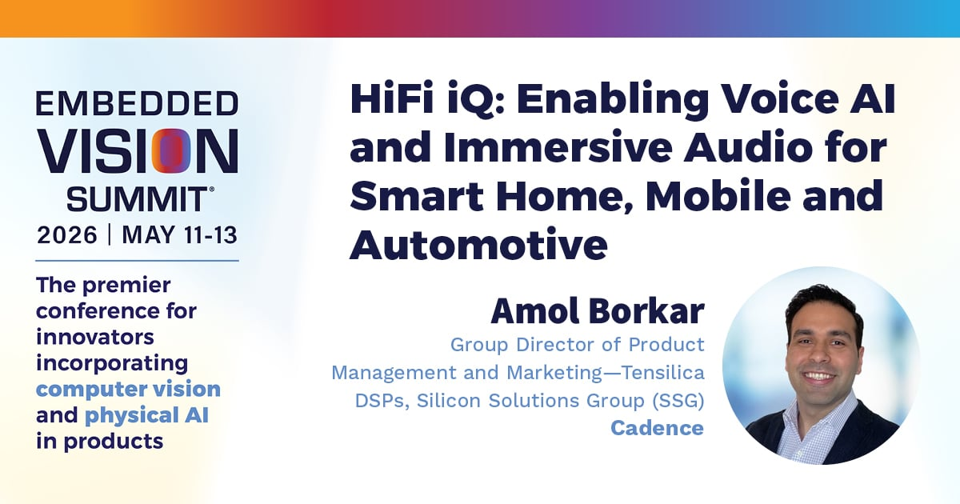
HiFi iQ: Enabling Voice AI and Immersive Audio for Smart Home, Mobile and Automotive Voice is quickly becoming the primary interface for consumer and enterprise devices, driven by improved speech models, small language models and the push for on-device processing to reduce latency and protect privacy. Delivering this experience requires always-on voice and audio pipelines—with features like keyword spotting, beamforming, ASR, noise reduction and immersive playback—with tight power budgets. In this talk, Amol Borkar, Group Director of Product Management and Marketing at Cadence, connects those requirements to silicon and software choices and introduces the sixth-generation Cadence Tensilica HiFi iQ DSP IP, designed for next-generation voice AI and immersive audio in markets such as smart home, mobile and automotive. He explores architectural choices that enable higher efficiency and programmability—2x compute, 8x AI performance, and greater than 25% energy savings versus HiFi 5s, expanded FP8/BF16 support and enhanced auto-vectorization—plus the developer ecosystem that accelerates deployment. |
 |
|
Building a Local Voice Agent on a Raspberry Pi In this top-rated talk, Pete Warden, CEO at Moonshine AI, explains everything you need to know to build your own voice agent running entirely on a stock Raspberry Pi 5, with no internet connection required. The end result is a system that enables you to speak commands or questions and hear responses in just a second or two. Going beyond speech recognition, the system includes intent recognition, enabling it to understand the purpose or goal behind a user’s input. Supported questions and responses are entirely customizable for your use cases. The system is built on the Moonshine Voice open-source library, which handles speech-to-text and intent recognition. |
UPCOMING INDUSTRY EVENTS |
FEATURED NEWS |
|
BrainChip has released the AKD1500 in a compact M.2 form factor for industrial and commercial designs Microchip Technology has signed a definitive agreement to acquire Hailo Image Quality Labs has introduced the Hummingbird global-shutter camera platform for Raspberry Pi 5 NVIDIA has expanded its Agent Toolkit with PhysicsNeMo and CUDA-X libraries OpenMV has released its V5.0.0 firmware |
EDGE AI AND VISION PRODUCT OF THE YEAR WINNER SHOWCASE |
.png?width=1120&upscale=true&name=Synaptics%20Astra%20Machina%20SL2610%20Development%20Kit%20(Best%20Edge%20AI%20Development%20Platform).png) |
|
Synaptics Astra Machina SL2610 Development Kit (Best Edge AI Development Platform) Synaptics’s Astra™ Machina SL2610 Development Kit has been awarded the 2026 Edge AI and Vision Product of the Year Award in the Edge AI Development Platforms category. The Synaptics Astra™ Machina SL2600 Series Development Kit enables advanced Edge AI and visual intelligence by bringing multimodal, transformer-class inference directly onto embedded IoT hardware. The open and flexible development kit is built on the AI-native Astra™ SL2600 processors, allowing vision, audio, language, and sensor data to be processed locally with low latency, robust privacy, and high energy efficiency. The most distinctive innovation of the SL2600 Series and its accompanying Development Kit is support for the Synaptics Torq™ Edge AI platform—a high-performance, low-power Edge AI Neural Processing Unit (NPU) subsystem. Torq is the industry’s first implementation of Google’s RISC-V–based Coral Open NPU with dynamic operator support enabling efficient execution of modern AI models—including vision transformers and multimodal pipelines—without proprietary toolchains or model constraints. The Astra platform reduces software lock-in by centering its Edge AI stack (Torq) on mainstream open-source building blocks—specifically a non-proprietary compiler/runtime based on IREE/MLIR—and by making key platform assets available through open-source methods. The kit’s modular hardware architecture further differentiates it from competitors. A configurable compute module, I/O baseboard, and expandable daughter cards support rapid prototyping of real-world vision systems with integrated connectivity, programmable I/O, and production-aligned interfaces. Please see here for more information on Synaptics’s Astra™ Machina SL2610 Development Kit. The Edge AI and Vision Product of the Year Awards celebrate the innovation of the industry’s leading companies that are developing and enabling the next generation of edge AI and computer vision products. Winning a Product of the Year award recognizes a company’s leadership in edge AI and computer vision as evaluated by independent industry experts. |