

LETTER FROM THE EDITOR |
 |
|
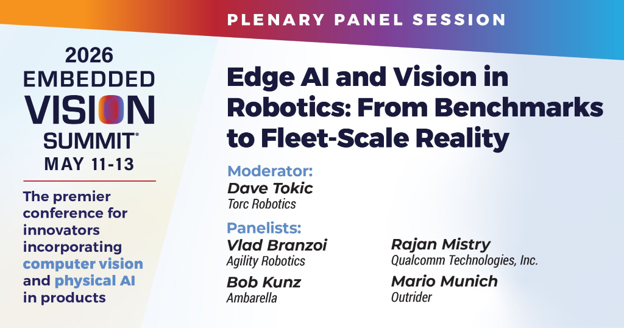
Dear Colleague, These days, it feels like practical AI is getting closer to the edge every week. In this issue, we’ll take a look at how performant models are getting smaller and more easily deployed in edge devices. We’ll delve into Google’s new Gemma 4 model family, and hear Analog Devices’ near-term forecast for physical AI. Insights on the latest trends in practical, deployable AI is one of the hallmarks of the Embedded Vision Summit program, and we have more news on that program today! Edge AI is helping robots see, decide and act in the real world—but the hardest work starts after the demo. In a plenary panel session at this year’s Embedded Vision Summit, our line-up of expert panelists will unpack where edge AI is creating measurable value today, then dive into the system choices that determine whether a robot ships: vision-only versus multimodal sensing and fusion, the real compute bottlenecks and the trade-offs between modular pipelines and end-to-end learned stacks. We’ll also discuss the data problem, plus the practical role of foundation and vision-language models in embodied systems. Finally, we’ll cover safety and trust around people, why pilots fail to scale, what changes from 10 robots to 1,000, and what breakthroughs are most likely to matter over the next three to five years. To explore these challenges and potential solutions, join Dave Tokic of Torc Robotics, as he moderates this lively panel discussion featuring Vlad Branzoi of Agility Robotics, Bob Kunz of Ambarella, Rajan Mistry of Qualcomm and Mario Munich of Outrider. The Embedded Vision Summit takes place May 11-13 in Santa Clara, California.
Without further ado, let’s get to the content. Erik Peters |
BUILDING AND DEPLOYING REAL-WORLD ROBOTS |
PERFORMANT AI GOES LOCAL |
 |
|
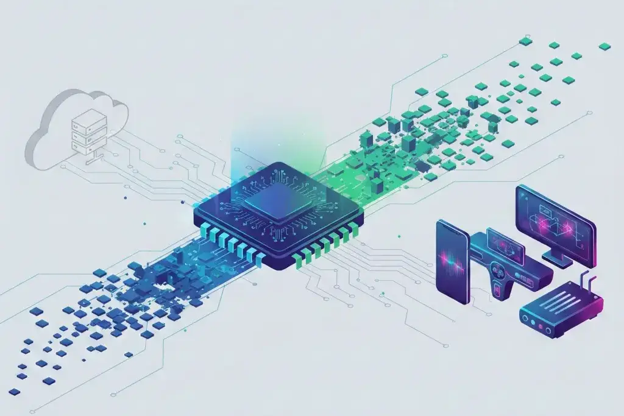
The On-Device LLM Revolution: Why 3B-30B Models Are Moving to the Edge Quadric examines why mid-sized language models in the 3B to 30B range are increasingly practical for deployment on edge systems rather than only in the cloud. It focuses on the hardware implications of that shift, including sustained tokens-per-second performance, power limits, long-context behavior, programmability and SoC integration constraints. The piece also reviews why common approaches such as GPUs and earlier NPU designs may be a poor fit for latency-sensitive, power-constrained edge inference. |
 |
|
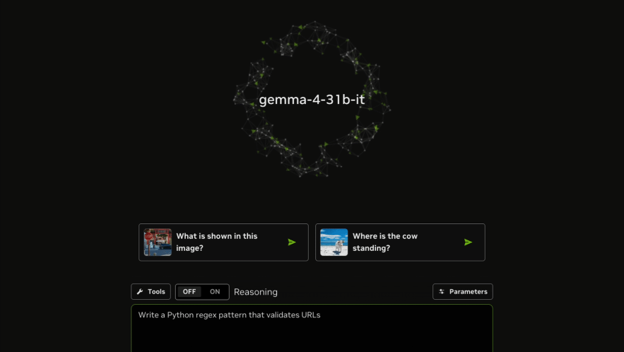
Bringing AI Closer to the Edge and On-Device with Gemma 4 NVIDIA provides an overview of Google’s new Gemma 4 model family and maps the different variants to data center, desktop, and edge deployment targets. It outlines the main model characteristics, including dense and mixture-of-experts options, multimodal support, multilingual coverage and context lengths, then connects those capabilities to platforms such as DGX Spark, RTX systems, and Jetson. The article also highlights the software paths NVIDIA is emphasizing for local deployment, including vLLM, Ollama, llama.cpp, NIM and NeMo-based fine-tuning. The article provides a practical guide to how Gemma 4 can be deployed across NVIDIA’s stack, from prototyping through edge and production use. |
BUILDING PHYSICAL INTELLIGENCE AT THE EDGE |
 |
|
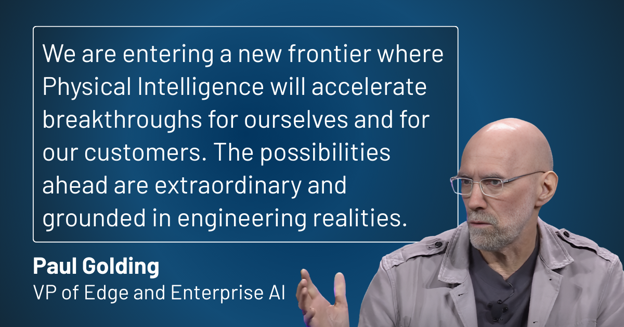
2026: The Year Intelligence Gets Physical Analog Devices presents its view of “physical intelligence,” defined here as AI systems that perceive, reason, and act locally on real-world signals such as motion, sound and other sensor data. The article is organized around five predictions for 2026, covering edge-based physical reasoning models, audio as an AI interface, few-shot robotics, compact domain-specific “micro-intelligences” and increasingly automated AI development loops. Rather than focusing on a single product, the piece sketches how sensing, mixed-signal design and local inference may converge across robotics, consumer devices and industrial systems. |
 |
|
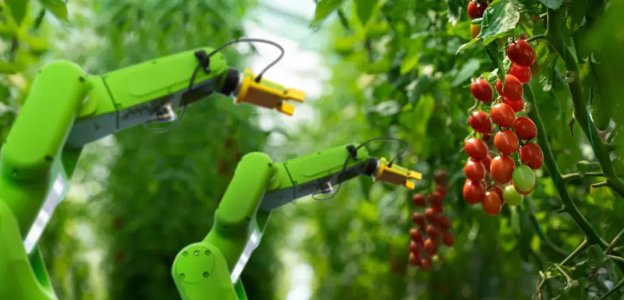
Building Robotics Applications with Ryzen AI and ROS 2 AMD provides a practical walkthrough for integrating its Ryzen AI hardware into a ROS 2 robotics pipeline. The article shows how to use the Ryzen AI Max+ 395 platform, the Ryzen AI CVML library and the Ryzers framework to package ROS 2, NPU drivers and perception models into one development environment. The example application wraps depth estimation, face detection and face mesh in a custom ROS 2 node, then connects those outputs to standard ROS 2 tools for visualization. It also explains how to extend the setup with other ROS 2 packages or live camera input. |
UPCOMING INDUSTRY EVENTS |
|
Remembering to Forget: Agentic Memory Systems and Context Constraints – Boston.AI Webinar: April 16, 10:00 am PT – BrainChip Webinar: April 20, 8:00 am PT Embedded Vision Summit: May 11-13, Santa Clara, California Newsletter subscribers may use the code 26EVSUM-NL for 10% off the price of registration until May 10. |
FEATURED NEWS |
|
Google has released the Gemma 4 family of open models, pushing multimodal AI further onto edge devices e-con Systems has launched STURDeCAM57: a 5MP global shutter RGB-IR camera for in-cabin monitoring systems Texas Instruments, D3 Embedded, Lattice and NVIDIA have showcased a practical radar-camera fusion stack for robotics BrainChip has unveiled a radar reference platform to bridge the “identification gap” in edge AI Intel has announced a strategic partnership with Google to deliver optimized Gemma 4 models on Intel hardware |