
Perforated AI has released an enhanced version of ResNet-18 designed to approach the accuracy of larger vision models without imposing a comparable increase in model size or computational cost. The pretrained model is now available for evaluation and transfer learning on Hugging Face.
The company’s technology adds artificial dendrites—additional computational structures inspired by biological neurons—to selected nodes in an existing neural network. Perforated AI says this approach enables individual neurons to learn more sophisticated feature representations, improving model accuracy more efficiently than simply adding conventional layers.
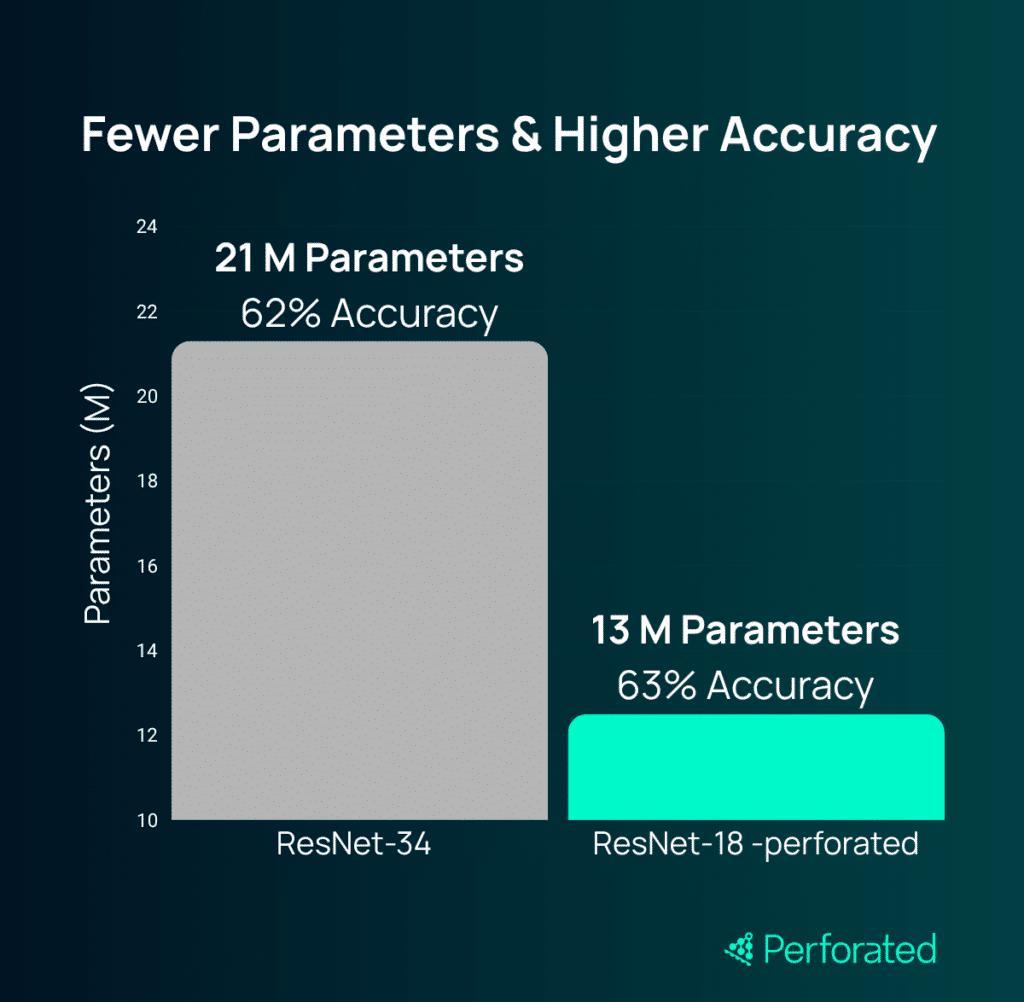
The resulting model contains approximately 12.5 million parameters, compared with roughly 11.7 million for a standard ResNet-18 and 21.8 million for ResNet-34. According to results reported by the company, the perforated ResNet-18 outperformed ResNet-34 on CIFAR-100 while adding only about 13% of the additional parameters that would be required to move from ResNet-18 to ResNet-34.
Perforated AI also evaluated the model as a transfer-learning backbone. Tests using the Oxford-IIIT Pets, Flowers-102 and Food-101 datasets showed performance substantially closer to ResNet-34 than to the original ResNet-18, despite the model’s much smaller parameter count. On Flowers-102, the perforated model achieved a reported accuracy of 91.2%, compared with 90.7% for ResNet-34 and 89.8% for ResNet-18.
The additional computation produced a relatively small latency increase in the company’s CPU testing. Perforated AI measured 4.37 ms per image for its model, versus 4.04 ms for ResNet-18 and 7.48 ms for ResNet-34. These results make the model potentially relevant for computer vision developers working with memory, processing or latency constraints.
Perforated AI provides additional benchmark results and an explanation of the technology in its longer technical article.
Developers can download and evaluate the pretrained model on Hugging Face. The company has also released a free, Apache 2.0-licensed version of its PyTorch software through the Perforated AI GitHub repository, enabling practitioners to experiment with adding dendritic structures to their own models.