
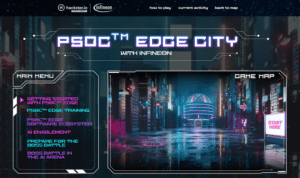
Introducing PSOC Edge City: A New Developer Education Program
This blog post was originally published at Infineon’s website. It is reprinted here with the permission of Infineon. Infineon and Hackster.io have launched PSOC™ Edge City, a guided educational developer program designed to build practical expertise
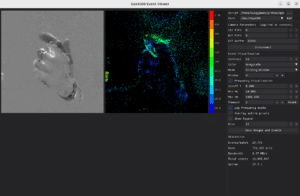
OpenMV v5.0.0 Firmware Released!
You can now make custom apps to control your camera easily! This news blog post was originally published at OpenMV’s website. It is reprinted here with the permission of OpenMV. Hi Everyone! We’re finally

BrainChip AKD1500 Now Available in Compact M.2 Form Factor, Enabling Edge AI in Industrial and Commercial Designs
Lower-cost, lower-power edge AI accelerator gives designers a plug-and-play path to upgrade legacy systems to Akida LAGUNA HILLS, Calif. – July 28, 2026 — BrainChip Holdings Ltd. (ASX: BRN, OTCQX: BRCHF, ADR: BCHPY), a global
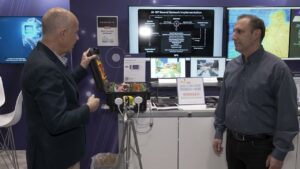
Visionary.ai ISP Powered by NPX6
David Jarmon, Sr. VP of Worldwide Sales at Visionary.ai, and Guy Ben Haim, Sr. Staff Product Manager, discuss Visionary.ai’s advanced AI-powered ISP demo. The solution delivers exceptional video quality with industry-leading low-light and HDR performance,
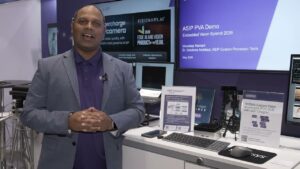
Custom Vision Accelerator (NVIDIA PVA) Built with ASIP Designer in Action
Viswateja Nemani, Sr. Staff Solutions Architect, showcases NVIDIA’s Programmable Vision Accelerator (PVA), a low-power VLIW/SIMD processor built with ASIP Designer using custom instructions tailored for vision and image workloads. The live demo runs real-time stereo

Free Webinar on Automotive Perception in the Physical AI Era
On September 29, 2026 at 9 am PT (noon ET), Pierrick Boulay, Principal Analyst, Automotive Semiconductors, and Anas Chalak, Technology & Market Analyst, Imaging at Yole Group, will present the free hour webinar “Automotive Perception
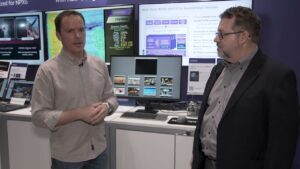
2.5 VL on NPX6 Silicon
Gordon Cooper, Principal Product Manager, and Alexey Brodkin, Director SW, present a demo showcasing the Qwen 2.5 VL real-time vision-language model running on existing silicon enabled by the ARC NPX NPU IP. The 48K MAC
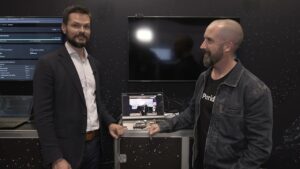
Avocado OS x Grinn: Rapid Physical AI Development on Edge Vision Hardware
At EVS 2026, Bill Brock, CEO of Peridio, joins Robert Atrea, CEO of Grinn Global, to announce a co-development partnership bringing Avocado OS to Grinn’s AstroSOM 1680 platform. Together, they demonstrate how Avocado OS integrates
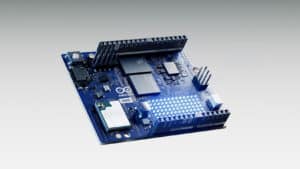
The Arduino UNO Q Board: Unpack the Dual-Brain Power for Next-Gen Edge AI
This blog post was originally published at Qualcomm’s website. It is reprinted here with the permission of Qualcomm. Get ready to reimagine what’s possible with Arduino! The new Arduino® UNO Q is shaking things up by bringing a

Microchip Advances Edge AI Sensor Connectivity with Rev 2.0 PolarFire® FPGA Ethernet Sensor Bridge
h3>Smaller, multi-camera platform enables scalable Ethernet architectures for NVIDIA Edge AI systems while lowering power, cost and integration complexity CHANDLER, Ariz., August 11, 2026 — The shift toward compact, high‑performance edge AI systems is redefining sensor connectivity, pushing developers to deliver power‑ and space‑efficient architectures that remain secure, scalable and future‑ready. To address these challenges, Microchip
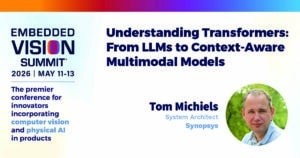
“Understanding Transformers: From LLMs to Context-Aware Multimodal Models,” a Presentation from Synopsys
Tom Michiels, System Architect at Synopsys presents “Understanding Transformers: From LLMs to Context-Aware Multimodal Models” at the May 2026 Embedded Vision Summit. Transformers have become the foundation of modern AI, reshaping how products are built and how businesses operate. In this talk Michiels explains why transformers replaced earlier models, what… “Understanding Transformers: From LLMs to

Your NPU Learned to Listen
Whisper runs end-to-end on Chimera. Encoder and decoder compiled as native GPNPU kernels, INT4 weights, FP16 attention, top-1 token match against the float32 reference. Scales to four cores with a flag, no recompile. This blog post was originally published at Quadric’s website. It is reprinted here with the permission of Quadric. I ran a

NVIDIA Alpamayo 2 Super, the Frontier Open Model for Robotaxis and Autonomous Vehicles, Now Available for Commercial Use
Open commercial licensing, benchmark‑leading reasoning and inspectable decisions bring autonomous vehicles, including robotaxis, closer to production and widescale deployment. This news blog was originally published at NVIDIA’ website. It is reprinted here with the permission of NVIDIA. For robotaxis and other autonomous vehicles (AVs), the hardest problems aren’t the everyday scenarios. They’re the rare, complex situations that

“Exploring Radar SLAM: Advancing Localization and Mapping for Automotive, Robotics and Beyond,” a Presentation from Cadence
Amit Kumar, Director of Product Management and Marketing at Cadence and Amit Sulakhe, Director in the Vision Group at Cadence Pune present “Exploring Radar SLAM: Advancing Localization and Mapping for Automotive, Robotics and Beyond” at the May 2026 Embedded Vision Summit. Reliable localization and mapping are foundational for autonomous vehicles… “Exploring Radar SLAM: Advancing Localization

What are the Key Engineering Challenges in Autonomous Docking Systems and How are they Solved? (Part 2)
This blog post was originally published at e-con Systems’ website. It is reprinted here with the permission of e-con Systems. Designing an ROS 2-based autonomous docking system is only half the story. Deploying it in the real world is another matter entirely. Since real industrial environments don’t cooperate with textbook assumptions, understanding these challenges will help
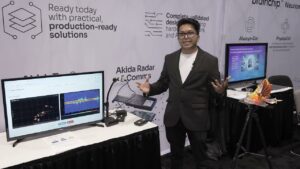
BrainChip Demonstration of the Company’s Always-On Radar-Based Edge Classification
Ritik Shrivastava, Solutions Architect at BrainChip, demonstrates Akida micro-doppler radar classification, a powerful radar-based object classification solution that runs entirely on-device without internet connection. Shrivastava showcases a live demo using BrainChip’s AKD1500 card attached to a Raspberry Pi, where the system detects and classifies between a bird and drone target in real time using radar.
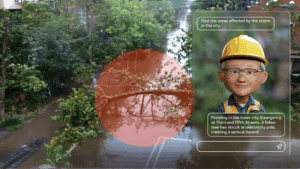
AI On: 3 Ways to Bring Agentic AI to Computer Vision Applications
This blog post was originally published at NVIDIA’s website. It is reprinted here with the permission of NVIDIA. Learn how to integrate vision language models into video analytics applications, from AI-powered search to fully automated video analysis. Today’s computer vision systems excel at identifying what happens in physical spaces and processes, but lack the abilities to explain the

SAM3: A New Era for Open‑Vocabulary Segmentation and Edge AI
Quality training data – especially segmented visual data – is a cornerstone of building robust vision models. Meta’s recently announced Segment Anything Model 3 (SAM3) arrives as a potential game-changer in this domain. SAM3 is a unified model that can detect, segment, and even track objects in images and videos using both text and visual