
LETTER FROM THE EDITOR |
 |
|
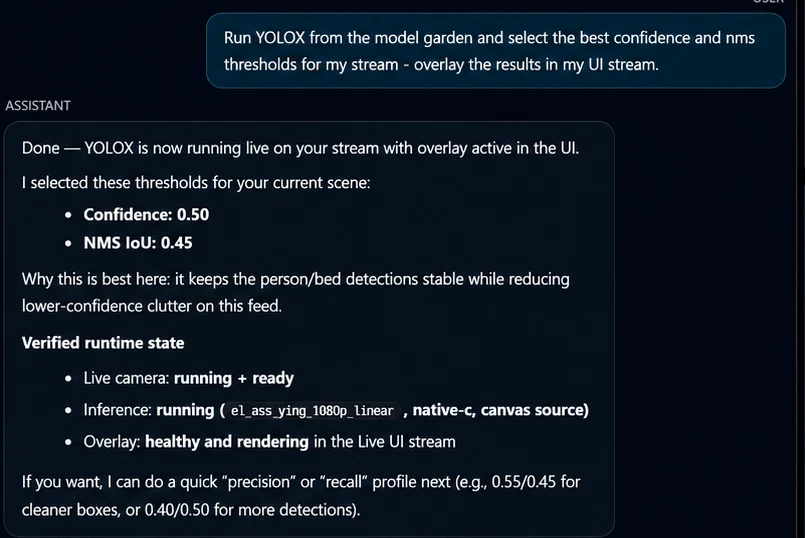
Dear Colleague, This week we’re looking at how edge AI and vision development is becoming more productive, more scalable and more accessible across real-world applications. Two upcoming webinars explore important pieces of this evolution: using edge-first coding agents to accelerate development for real devices, and making computer vision easier to deploy across a broad range of edge verticals. Also in this issue, we highlight presentations on bringing advanced vision-language-action models to embedded systems, optimizing NPUs for transformer workloads and scaling edge AI from prototypes to production deployments. Many of our readers are eager to share their expertise with peers, and I’m pleased to announce that the Call for Presentation Proposals for the 2027 Embedded Vision Summit is now open! The 2027 Summit will take place February 2-4 in San Francisco, California. We would love to see your ideas—from physical AI case studies to efficient edge AI techniques to the latest advances in vision-language models. Check out the 2027 topics list on the Call for Proposals page for inspiration and to submit your proposal by August 14th. As I mentioned, we have two more webinars to announce. First, on Tuesday, August 25, we’ll present a webinar on edge-first coding agents in collaboration with Ambarella. Coding agents are usually built as cloud-first abstractions. But for developing trustworthy, production-ready edge systems, Ambarella believes that coding agents should be designed from the edge outward—where privacy, bandwidth and real-time requirements are real constraints. In this talk, Pietro Antonio Cicalese, Senior Technical Marketing Engineer, will show how Ambarella is reimagining coding agents for heterogeneous edge AI/computer vision development: separating reasoning from execution, routing capabilities explicitly, checking runtime constraints, validating actions against observed device behavior and providing inspectable evidence and fallbacks. He’ll also make this approach concrete with Ambarella’s Cooper Developer Platform, which unifies hardware and software bring-up, optimized models and multimodal pipelines and low-code/no-code agentic blueprints that turn high-level intent into deployable edge workflows. More info here. |
 |
|
On Thursday, September 17, we’ll present a webinar on Qualcomm Accessible Computer Vision. Computer vision at the edge is no longer limited by algorithms; it is constrained by power, latency, system complexity and deployment friction across platforms. In this talk, Derrick Chang, Senior Product Manager, will share how Qualcomm is making computer vision more accessible across edge verticals through a common, scalable computer vision foundation. Qualcomm Accessible Computer Vision (QACV) brings together optimized computer vision and AI pipelines, hardware‑aware design and reusable libraries to enable deployable end‑to‑end vision solutions. He will focus on the underlying technology, design principles and developer experience and discuss how developers can engage with this computer vision foundation for their own edge applications. More info here. Without further ado, let’s get to the content. Erik Peters |
BUILDING AND DEPLOYING REAL-WORLD ROBOTS |
BRINGING LARGE MULTIMODAL MODELS TO THE EDGE |
 |
|
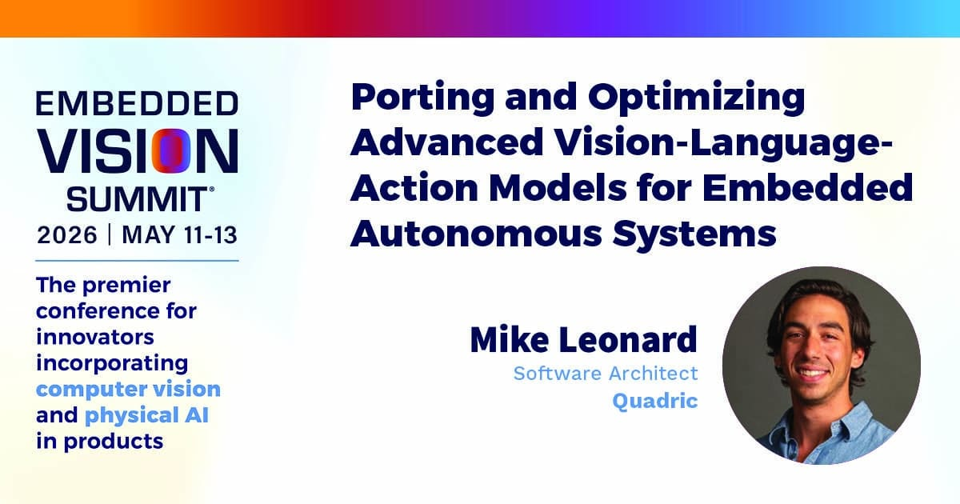
Porting and Optimizing Advanced Vision-Language-Action Models for Embedded Autonomous Systems World-scale vision-language-action (VLA) models are the new frontier in AI for autonomous driving and robotics, enabling systems to perceive, reason and act in complex real-world environments. Using the open-source Pi-0.5 model as an exemplar, Mike Leonard, Software Architect at Quadric, reviews the structure of VLA models and examines how they combine advanced techniques from both language and vision transformers into a unified architecture. He then examines the unique challenges VLAs introduce for embedded deployment, including quantization complexity and a mix of compute-dominated and bandwidth-bottlenecked workloads that must be handled efficiently. He also explores practical strategies for mapping VLA workloads to embedded compute engines and presents results from porting and optimizing Pi-0.5 on Quadric’s Chimera GPNPU, showing how Chimera’s combination of software control and determinism makes it uniquely well-suited to optimized VLA inference at the edge. |
 |
|
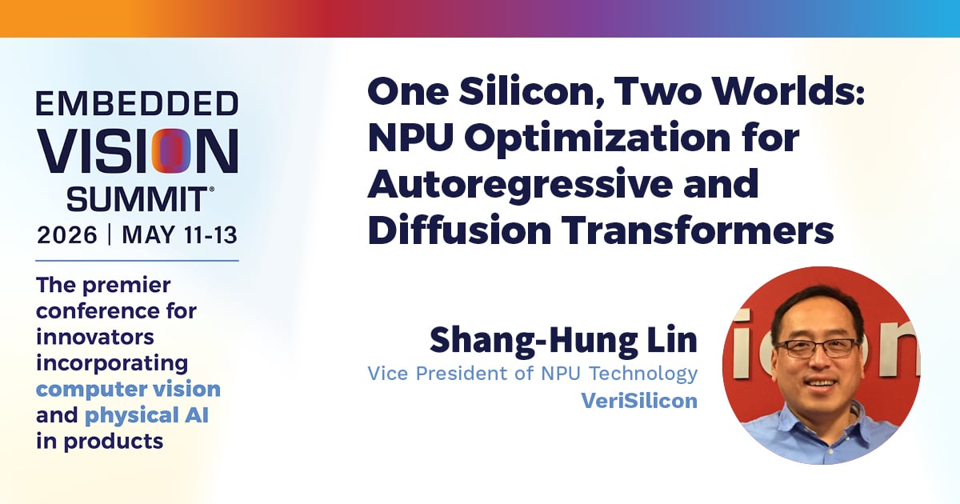
One Silicon, Two Worlds: NPU Optimization for Autoregressive and Diffusion Transformers Physical AI is caught between two computational titans: autoregressive (AR) transformers, which predict discrete action tokens, and diffusion transformers (DiTs), which refine continuous motion trajectories. Both architectures face a “memory wall,” but for different reasons: AR is bottlenecked by the sequential growth of the KV cache, while DiT is strained by repetitive denoising loops. Shang-Hung Lin, Vice President of NPU Technology at VeriSilicon, analyzes how next-generation neural processing units (NPUs)—including Google Coral and VeriSilicon Vivante IP—are being re-engineered to handle both. He explores specialized caching schemes like selective KV reuse and hardware-aware FlashAttention that minimize memory bandwidth. By optimizing the silicon for both discrete “thinking” and continuous “acting,” these NPU strategies enable battery-operated robots to maintain real-time response across the entire physical AI life cycle. |
FROM EDGE AI PROTOTYPES TO PRODUCTION DEPLOYMENT |
 |
|
From Prototype to Production: What Computer Vision Teams Wish They Knew at 100 Devices Your computer vision prototype works beautifully: USB camera on a Jetson dev kit, software humming, investors impressed. Production isn’t that convenient. It brings MIPI‑CSI buses, custom kernel drivers, device‑tree overlays—and complexity most teams meet too late. In this talk, Justin Schneck, Co-Founder and CTO at Peridio, walks the real path from prototype to product: why JetPack breaks down at scale, why jumping to raw Yocto can create long‑term maintenance debt, and how a third approach keeps a fast development loop while shipping reliably. He shows how Peridio and Avocado OS provide that path: a production‑grade platform that manages the kernel, BSP and device lifecycle so you can deploy and update CV devices at scale without becoming embedded Linux experts. Learn to absorb rising hardware complexity—from dev‑kit camera modules to off‑the‑shelf systems to fully custom carrier boards—while your team stays focused on the software that drives business value. |
 |
|
Navigating Physical AI Deployment Across Multiple Platforms for Automated Optical Inspection As automated optical inspection moves from the server room to the factory floor, the promise of “seamless” AI deployment often hits the reality of hardware-specific friction. For embedded vision engineers, the challenge isn’t just training a high-accuracy model—it’s ensuring that model survives the transition to power-constrained edge silicon without losing its functional integrity. In this talk, Barrie Mullins, Assistant Vice President at eInfochips (an Arrow company), provides a technical dive into the practical realities of deploying deep learning models for high-speed optical inspection across three industry-leading platforms: NVIDIA’s Jetson, Qualcomm’s Snapdragon and NXP’s i.MX + Ara-2. He looks beyond the marketing benchmarks to explore the “middle-mile” of AI implementation, including model development and training, vision pipeline differences and trade-offs, implications of model compilers for operator support and performance, power and thermal trade-offs. He illustrates these factors using a reference pill inspection system implemented on the three platforms. |
UPCOMING INDUSTRY EVENTS |
FEATURED NEWS |
|
MemryX has expanded its Cascade platform, bringing power-efficient edge AI to servers Synaptics has introduced the SRW1500 series single-chip AI MCU SiMa.AI has partnered with Mistral Solutions to accelerate autonomous drone intelligence STMicroelectronics has unveiled its first direct Time-of-Flight (dToF) 3D LiDAR all-in-one module, the VL53L9 BrainChip has announced the Akida Communication Reference Platform, a physical development platform for RF signal classification |
EDGE AI AND VISION PRODUCT OF THE YEAR WINNER SHOWCASE |
 |
|
Nota AI Nota Vision Agent (Best Edge AI Large Multimodal Model) Nota AI’s Nota Vision Agent has been awarded the 2026 Edge AI and Vision Product of the Year Award in the Edge AI Large Multimodal Models category. NVA (Nota Vision Agent) is Nota AI’s flagship generative AI video monitoring solution that transforms traditional video feeds into intelligent, conversational insights. Unlike conventional computer vision (CV)-based object detection focused on predefined objects, NVA leverages a Vision Language Model (VLM) to interpret complex scenarios and generate real-time text descriptions, safety reports and incident summaries. Serving mission-critical sectors such as transportation, industrial safety, logistics and national defense, NVA enables organizations to shift from passive monitoring to proactive, AI-driven decision-making. Key features include:
Please see here for more information on Nota AI’s Nota Vision Agent. The Edge AI and Vision Product of the Year Awards celebrate the innovation of the industry’s leading companies that are developing and enabling the next generation of edge AI and computer vision products. Winning a Product of the Year award recognizes a company’s leadership in edge AI and computer vision as evaluated by independent industry experts. |