


Ebttikar and MemryX Form Strategic Partnership to Accelerate Computer Vision Edge AI Across Saudi Arabia
RIYADH, Saudi Arabia, July 9, 2026 /PRNewswire/ — Ebttikar Technology Company, a Saudi technology solutions provider and systems integrator, and MemryX Inc., a developer of edge AI inference accelerator chips, today announced a strategic partnership to accelerate the commercial deployment of production-ready Computer Vision Edge AI solutions across Saudi Arabia, with potential expansion to qualified opportunities in

Free Webinar on Designing Computer Vision for the Far Edge
On September 24, 2026 at 9 am PT (noon ET), Nicolas Widynski, AI Fellow at Lattice Semiconductor, will present the free hour webinar “Efficient Computer Vision at the Far Edge: Design and Training Under Constraints,” organized by the Edge AI and Vision Alliance. Here’s the description, from the event registration page: This session explores practical

Upcoming Webinar on Agentic Smart City Systems
On July 29, 2026 at 10:00 am PT (1:00 pm ET), Intel will present the webinar “Agentic Smart City Systems: Real-Time Traffic Orchestration.” Here’s the description, from the event registration page: Beat congestion, save time, and route smarter in this hands-on, gamified workshop where Agentic AI meets Edge AI to power next-generation smart cities and

Beyond TOPS: The First Full-Pipeline AI Vision Benchmark
Beyond TOPS: The First Full-Pipeline AI Vision Benchmark EdgeFirst Perception Index profiles the entire perception pipeline — from CoreML to CUDA, desktop GPU to sub-7-watt edge NPU — and is the first independent benchmark to validate YOLO26 on edge hardware. The Q2 edition includes 330+ full validation sessions of 4 Ultralytics YOLO model families (21

Lattice FPGA Embedded Vision: Real-Time ISP Pipeline with Integrated Tuning Tool
Lattice Semiconductor demonstrates a complete end-to-end vision pipeline running entirely on an FPGA, from CSI camera input to screen output. Raw sensor data is processed by an on-chip ISP that converts it to a clean YUV 422 video stream in real time. The platform includes a dedicated ISP builder and tuning tool, allowing designers to

Video over Ethernet on Lattice CrossLink™-NX FPGA: Microsecond Latency Demo
Tecphos demonstrates real-time video over Ethernet using a Lattice CrossLink-NX 40 FPGA at the Embedded Vision Summit. The FPGA captures raw image data from a MIPI image sensor, processes and scales it, and simultaneously delivers an uncompressed stream to the host while compressing it to JPEG on-chip. Compressed data is formatted into Ethernet packets and
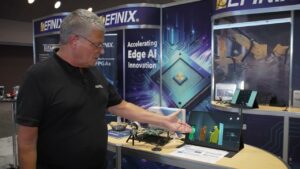
Mark Oliver Demonstrates AI Segmentation Accelerated in Hardware AI Accelerators on the FPGA Fabric
Mark Oliver, the VP of Marketing at Efinix demonstrates how multiple AI models can be compiled to run on dedicated AI accelerators implemented in the high performance Titanium FPGA family. He shows how Efinix supplied tools can be used to optimize an AI model to run on an AI accelerator delivering hardware level performance while
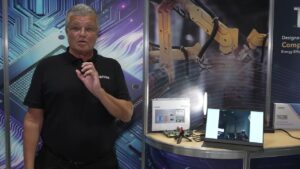
Mark Oliver Demonstrates the Power of Custom Instruction Acceleration for Edge AI
Mark Oliver, the VP of Marketing at Efinix demonstrates the ability to run four independent AI models on the hardened quad core processor inside the Titanium family of FPGAs. He shows how an intuitive software flow can be accelerated through custom instructions to run “bottle neck” software routines in the FPGA fabric at hardware speed
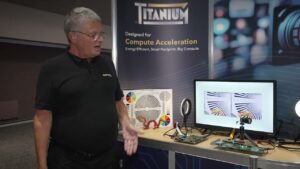
Mark Oliver Demonstrates Super Resolution on the Power-Efficient Efinix Titanium FPGAs
Mark Oliver, the VP or Marketing at Efinix demonstrates the superior performance of an AI algorithm to perform super resolution on a low resolution image. This approach is only feasible due to the low power consumption and superior performance of the Efinix Titanium family of FPGAs meaning that the super resolution functionality can be placed

Cadence x MosChip Demo: On-Device SLM Voice Agent on a Vision DSP (Cloud-Free Conversational AI)
This demonstration by MosChip and Cadence shows a Small Language Model (SLM) voice assistant running entirely on-device on the Cadence Tensilica Vision Q7 DSP within an Axera AX650N platform – with no cloud connection. It walks through the full interaction loop: spoken input is converted to text, a compact quantized language model (SLM) generates

Vedya Labs Demonstration of Stable Diffusion Deployment on Cadence Tensilica DSPs
Suresh Pasupuleti, Managing Director of Vedya Labs, presents the company’s work in bringing Stable Diffusion-based image generation to DSP-centric embedded platforms. The demonstration showcases a nearly 500-million-parameter model running on the Axera AX650N SoC, with the text encoder, U-Net, and VAE stages optimized for dual Cadence Tensilica Vision DSPs. Using INT8 quantization and a combination

Bolom Sound Classification on Cadence Tensilica HiFi 5
Mauricio Greene of Bolom demonstrates real-time Sound Classification running on the Cadence Tensilica HiFi 5 DSP at the Embedded Vision Summit. Bolom Acoustic Intelligence edge models identify hundreds of distinct sound events and soundscape scenes – such as sirens, alarms, horns, traffic and more, fully on-device and without relying on the cloud. The Tensilica HiFi

When the Edge Is 400 Kilometers Up: AI, Space, and the Limits of Cloud Computing
This blog post was originally published at Ambarella’s website. It is reprinted here with the permission of Ambarella. The orbital community has reached the same conclusions that the broader edge AI industry has been articulating for years: If moving the data is more expensive than moving the result, the processing belongs where the data was produced. The

HTEC White Paper Outlines the Convergence of Edge AI, Semiconductor Software, and Autonomous Systems
This content was originally published at HTEC’s website. It is reprinted here with the permission of HTEC. Physical AI at the Edge: Building the Full Stack for Real-World Deployment For years, AI progress was measured by model benchmark scores. The real test is different: does it work when deployed in a vehicle, a factory, a
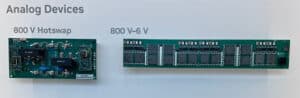
Powering the Next Generation of NVIDIA AI Factories with MGX
This blog post was originally published at Analog Devices’ website. It is reprinted here with the permission of Analog Devices. As AI workloads accelerate, the shift toward AI factories are driving unprecedented rack-level power density. At the center of this transition is NVIDIA MGX™, an open modular architecture that enables faster system design, improved scalability and rapid

“From Chips to Platforms: Scaling Edge AI with SoMs, Production Linux and Secure Life-Cycle Ops,” a Presentation from Peridio
Amir Sherman, Head of Global Business Development at Peridio presents “From Chips to Platforms: Scaling Edge AI with SoMs, Production Linux and Secure Life-Cycle Ops” at the May 2026 Embedded Vision Summit. Edge AI has moved beyond choosing a single chip or platform. Teams now face a harder question: how… “From Chips to Platforms: Scaling
MemryX Expands Cascade Platform, Bringing Power-Efficient Edge AI to Servers
Introducing an expanded portfolio of modules that gives developers a single, scalable architecture to power everything from low-power devices to enterprise edge infrastructure ANN ARBOR, Mich., June 22, 2026 /PRNewswire/ — As AI moves from cloud environments into factories, transportation systems, robotics, and intelligent infrastructure, developers face growing challenges related to power consumption, memory bandwidth, deployment complexity,

“Porting and Optimizing Advanced Vision-Language-Action Models for Embedded Autonomous Systems,” a Presentation from Quadric
Mike Leonard, Software Architect at Quadric presents “Porting and Optimizing Advanced Vision-Language-Action Models for Embedded Autonomous Systems” at the May 2026 Embedded Vision Summit. World-scale vision-language-action (VLA) models are the new frontier in AI for autonomous driving and robotics, enabling systems to perceive, reason and act in complex real-world environments.… “Porting and Optimizing Advanced Vision-Language-Action
Powering Edge AI at Scale: Synaptics Astra SRW1500 Series Single-Chip AI MCU
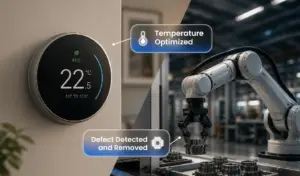
This blog post was originally published at Synaptics’ website. It is reprinted here with the permission of Synaptics. From the early days of the Internet of Things (IoT), connected devices have been highly effective at sensing and processing real-world inputs. But as AI workloads grow more demanding and real-time responsiveness becomes critical, the value is no

BrainChip Unveils Communication Reference Platform, Fueling Signal Intelligence at the Edge
LAGUNA HILLS, Calif. – June 23, 2026 – BrainChip Holdings Ltd. (ASX: BRN, OTCQX: BRCHF, BCHPY), the first commercial producer of neuromorphic artificial intelligence technology, today announced the Akida Communication Reference Platform, a physical development platform for RF signal classification using BrainChip’s Akida AKD1500 neuromorphic processor. The platform is a critical tool for defense contractors and government agencies