
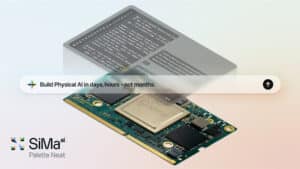
SiMa.ai Launches Palette Neat, Industry’s First Agentic Environment for Physical AI; Slashes Development from Months to Days
Palette Neat, alongside the production-ready, pin-compatible Modalix™ SoM, dismantles the legacy GPU moat to scale Physical AI SAN JOSE, Calif. — June 16, 2026 — SiMa.ai, a leader in Physical AI, today launched Palette Neat™, the industry’s first agentic development environment for Physical AI that collapses complex application timelines from months to days. The
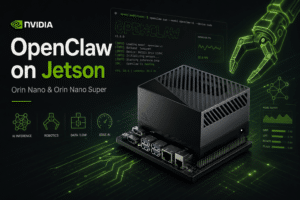
OpenClaw on Jetson (Part 1)
This blog post was originally published at NVIDIA’s website. It is reprinted here with the permission of NVIDIA. OpenClaw also works on Jetson devices. You can run it on a Jetson AGX Orin or AGX Thor, but even if you have a Jetson Orin Nano (8GB), you can still run it locally with the right setup. In this guide we
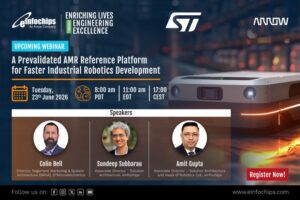
Upcoming Webinar to Introduce Industrial Robotics Reference Platform
On June 23, 2026, at 8:00 am PDT (11:00 am EDT / 17:00 CEST) STMicroelectronics, eInfochips and Arrow will deliver a webinar “A Prevalidated AMR Reference Platform for Faster Industrial Robotics Development” From the event page: STMicroelectronics and Arrow Electronics are introducing a new industrial autonomous mobile robot (AMR) reference platform built to help teams

“How Qualcomm Is Making Computer Vision Accessible Across Edge Verticals,” a Presentation from Qualcomm Technologies, Inc.
Derrick Chang, Senior Product Manager at Qualcomm Technologies, Inc. presents “How Qualcomm Is Making Computer Vision Accessible Across Edge Verticals” at the May 2026 Embedded Vision Summit. Computer vision at the edge is no longer limited by algorithms; it is constrained by power, latency, system complexity and deployment friction across… “How Qualcomm Is Making Computer

Why Multi-Robot Autonomous Mapping Is Becoming Essential for Large-Scale Facilities (Part 1)
This blog post was originally published at e-con Systems’ website. It is reprinted here with the permission of e-con Systems. For years, facility digitization has relied on a single, expensive robot slowly traversing every corridor of a warehouse, laboratory, or industrial plant. While effective, this approach is linear, which clashes with the fact that facilities are

“From Prototype to Production: What Computer Vision Teams Wish They Knew at 100 Devices,” a Presentation from Peridio
Justin Schneck, Co-Founder and CTO at Peridio presents “From Prototype to Production: What Computer Vision Teams Wish They Knew at 100 Devices” at the May 2026 Embedded Vision Summit. Your computer vision prototype works beautifully: USB camera on a Jetson dev kit, software humming, investors impressed. Production isn’t that convenient.… “From Prototype to Production: What

“Enabling “GenAI Everywhere”: Flexible Model Compatibility and Insight-Driven Workflows,” a Presentation from Nota AI
Tae-Ho Kim, Co-Founder and CTO at Nota AI presents “Enabling “GenAI Everywhere”: Flexible Model Compatibility and Insight-Driven Workflows” at the May 2026 Embedded Vision Summit. As generative AI models rapidly evolve—with increasingly dynamic transformer architectures and diverse framework variations—the challenge of bringing these models to the edge has grown dramatically.… “Enabling “GenAI Everywhere”: Flexible Model

Four Generations of the Rapidflare Agent Harness – Spark, Flame, Blaze and Forge
How the Rapidflare agent harness has evolved across four generations — from a simple RAG pipeline in 2023 to a long-running, broader, deeper harness in 2026. This blog post was originally published at Rapidflare’s website. It is reprinted here with the permission of Rapidflare. Since the start of Rapidflare, we have shipped four distinct

MicroIP and BrainChip Announce Strategic Ecosystem Partnership to Deliver Advanced Edge AI Hardware and Software
LAGUNA HILLS, Calif. and HSINCHU CITY, TAIWAN – June 2, 2026 – BrainChip Inc., a leading provider of ultra-low-power, neuromorphic AI semiconductor intellectual property, today announced a strategic eco-system partnership agreement with MicroIP, an expert in hardware and software products, machine learning (ML) applications, models and ASIC designs. Under the terms of the agreement, the two companies
JetPack 7.2: The Production Moment for Physical AI
NVIDIA just shipped the most important Jetson release in years. Here’s what it means — and where Avocado OS fits in. This blog was originally published at Peridio’s website. It is reprinted here with the permission of Peridio. A couple weeks ago, the Peridio team was together at our Nashville HQ for our exec
“Accelerating Deep Learning Models on AMD Adaptive SoCs with the AMD Vitis AI Workflow,” a Presentation from AMD
Thomas Zerbs, Technical Marketing Engineer, Adaptive and Embedded Computing Group at AMD presents “Accelerating Deep Learning Models on AMD Adaptive SoCs with the AMD Vitis AI Workflow” at the May 2026 Embedded Vision Summit. In this presentation, we provide a practical end-to-end overview of the AMD Vitis™ AI workflow for… “Accelerating Deep Learning Models on
“Accelerating Physical AI with ROCm: High-Performance ML on AMD Embedded iGPUs,” a Presentation from AMD
Alok Gupta, Senior Technical Marketing Manager at AMD presents “Accelerating Physical AI with ROCm: High-Performance ML on AMD Embedded iGPUs” at the May 2026 Embedded Vision Summit. Discover how AMD’s ROCm software stack unlocks data center-class ML performance on embedded integrated GPUs, enabling diverse AI workloads from CNNs and transformers… “Accelerating Physical AI with ROCm:

“Edge-First Coding Agents: Trustworthy Agentic Development for Real Devices,” a Presentation from Ambarella
Pietro Antonio Cicalese, Senior Technical Marketing Engineer at Ambarella, presents “Edge-First Coding Agents: Trustworthy Agentic Development for Real Devices” at the May 2026 Embedded Vision Summit. Coding agents are usually built as cloud-first abstractions. But for developing trustworthy, production-ready edge systems, we’ve found that coding agents should be designed from… “Edge-First Coding Agents: Trustworthy Agentic
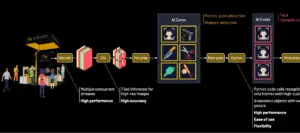
Scaling Edge AI for the Enterprise: Building the Ultimate Multi-Model, Multi-Stream Security System
This blog post was originally published at Axelera AI’s website. It is reprinted here with the permission of Axelera AI. At a Glance The Achievement: Real-time AI person-of-interest (POI) identification and threat detection across multiple 8K streams at 2.5 PetaOPS The Stack: Voyager SDK + Axelera Metis + Intel Xeon The Future: 3x performance leap with

AMD’s Embedded Computing Summit Comes to London and Eindhoven
On June 16, 2026 in London, and on June 18, 2026 in Eindhoven, the AMD “Embedded Computing Summit Global Technical Tour” comes to Europe. From the event page: Where Embedded Innocation Meets Technical Depth The Embedded Computing Summit (ECS) Global Technical Tour is the premier in-person technical event series from AMD, bringing together engineers, architects,

Upcoming Webinar on Building Your First Real-World AI Tool
On May 21, 2026, at 1:00 pm EDT (10:00 am PDT) Boston.AI will deliver a webinar “What It Takes to Build Your First Real-World AI Tool” From the event page: Most AI talks focus on what’s possible. This one shows how to actually use AI in product development, even if you’re just getting started. In
AMD Silo AI and University of Bologna Start Spatial AI Collaboration for Robotics and Autonomous Driving
The research collaboration will focus on building geometry-aware perception modules on the AMD ROCm™ open software stack AMD Silo AI and University of Bologna through its Department of Computer Science and Engineering (DISI) are starting a research collaboration to bring explicit 3D geometry into the Vision Language Action (VLA) and world-model pipeline for robotics and

The Next Frontier in AI Is Not Just Reasoning. It Is Knowing When to Look Again
Why AI Metacognition Requires Hierarchical Random-access Data This blog post was originally published at V-Nova’s website. It is reprinted here with the permission of V-Nova. Executive Summary (TL;DR) Today’s AI systems can reason impressively, but they still struggle to know when to look again. Humans use metacognition as a feedback loop between thought and perception: