
This blog post was originally published at ENERZAi’s website. It is reprinted here with the permission of ENERZAi.
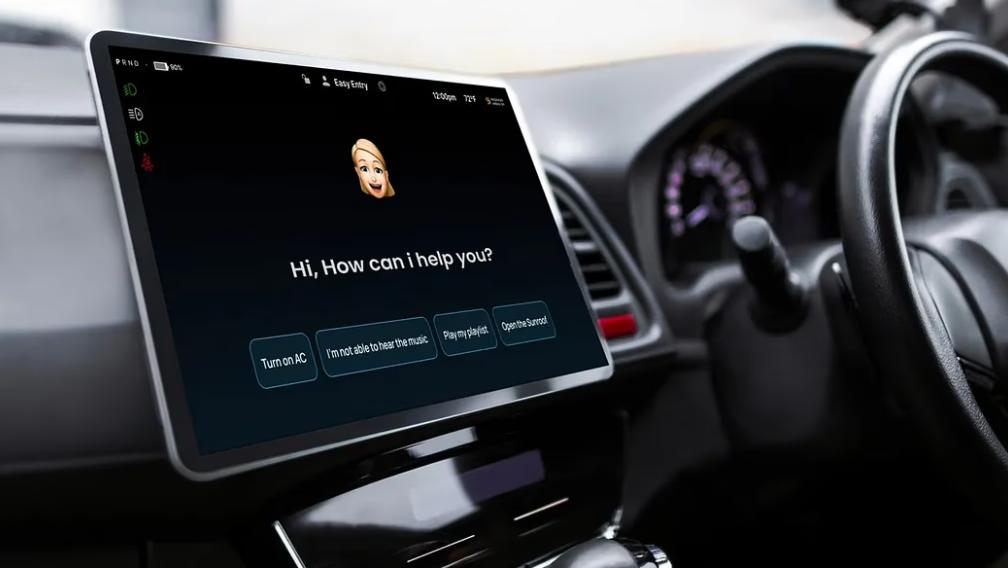
Hyundai Motor Group recently introduced Gleo AI — a conversational voice AI agent — in the all-new Grandeur, marking the first time such a system has appeared in one of their production vehicles. Unlike traditional voice recognition, which only responds to fixed commands, Gleo AI understands context, driving conditions, and even where in the cabin the speaker is located. It’s a clear signal: as vehicles shift toward the Software-Defined Vehicle (SDV) paradigm, the primary interface between driver and car is moving away from buttons and screens, and toward voice.

Source: Hyundai Motor Group
But behind this smart voice assistant sits a more fundamental question: where does all the computation actually happen? Interestingly, major OEMs including Mercedes-Benz are moving in the same direction: reducing cloud dependency and running AI directly inside the vehicle. Why would they turn to on-device when the cloud is so powerful?
In this post, we’ll explore how voice AI is being deployed in automotive, one of the most active frontiers for on-device AI research, why OEMs are making this shift, and how ENERZAi’s ultra-lightweight voice and language AI can address the real challenges facing automotive OEMs and digital cockpit manufacturers.
TL;DR
- As vehicles transition to Software-Defined Vehicles (SDVs), the digital cockpit has become the primary battleground. And at the center of it all is the voice AI interface connecting drivers to their cars. The market for AI-powered automotive cockpits and assistants is projected to grow from approximately $7.1B in 2025 at a CAGR of 22.2% through 2035.
- Automotive voice AI is evolving beyond navigation, climate control, and infotainment — into a true AI assistant that understands natural language and interprets driver intent.
- However, most in-vehicle voice AI today is cloud-based, which comes with fundamental limitations in automotive contexts: failure in dead zones (tunnels, underground garages, rural roads), latency that undermines the driving experience, mounting per-vehicle operational costs, and privacy concerns around in-cabin voice data.
- Leading OEMs like Mercedes-Benz and Hyundai Motor Group are actively working to reduce cloud dependency and increase the share of AI processing handled on-device. But delivering stable, high-quality performance under the memory and compute constraints of in-vehicle hardware remains a serious engineering challenge.
- ENERZAi aims to accelerate on-device AI innovation in the automotive industry through ultra-lightweight voice AI agents purpose-built for the in-vehicle environment, powered by our differentiated AI compression and optimization technology.
AI@Car
Talking to your car without ever taking your hands off the wheel is quickly becoming the norm. Traditionally, in-vehicle voice features could only recognize fixed commands such as “start navigation,” “play music.” But today’s automotive voice AI has evolved to support natural conversation, powered by advances in natural language processing (NLP).
Driving this shift is the broader transition to Software-Defined Vehicles (SDVs). As vehicle functionality moves from hardware to software, the real competitive arena for OEMs has become the digital cockpit. And at the heart of that cockpit experience is the voice assistant: the most natural interface between driver and vehicle.

Source: HARMAN
The market reflects this momentum. The AI-powered automotive cockpit and assistant market is estimated at around $7.1B in 2025, with projected CAGR of 22.2% from 2026 through 2035 — driven by growing consumer demand for hands-free interaction and personalization, alongside regulatory pressure to improve road safety.

Source: Global Market Insights
Key Use Cases
Automotive voice AI started with simple command control, but it’s rapidly expanding into a unified interface that spans the entire vehicle. Here are the main application areas:
① Climate Control & Vehicle Settings
- “Direct airflow to my feet,” “Cool down just the rear seats” → zone- and seat-level climate control
- Hands-free control of seat heating/ventilation, windows, sunroof, and ambient lighting
- “It feels stuffy in here” → automatic activation of ventilation or air purification mode
② Navigation & Route Guidance
- “If the commute is heavy, reroute me” → real-time traffic-aware route recalculation
- “Stop by a charging station on the way” → automatic waypoint insertion
- Voice search for parking and points of interest near the destination
③ Vehicle Status & Management
- “How much range do I have left?” → voice readout of fuel/battery and vehicle health
- Maintenance reminders and warning light explanations
④ Infotainment (IVI) & Content Recommendations
- “Play something mellow,” “Resume the podcast I was listening to yesterday” → context- and history-aware playback
- Unified voice control and media search across music, radio, and audiobooks
More recently, the field is moving beyond voice-only interaction toward multimodal interfaces (voice + gesture + gaze), emotion recognition that reads driver tone and biometric signals, and full integration of LLM-based conversational assistants into the vehicle.
Why On-device?
Most voice AI features in today’s vehicles run on cloud infrastructure. Voice data captured by the car’s microphone is sent to a remote server, processed, and the result is sent back to the vehicle. The cloud offers virtually unlimited compute — but in the context of a car, it runs into some fundamental walls.
1. Dead zones: when the connection drops, so does the assistant
In tunnels, underground parking structures, mountain roads, and rural stretches, cloud-based voice AI simply stops working. But these are exactly the kinds of environments a car passes through constantly. A voice assistant that only works when you have connectivity is fundamentally mismatched with how cars are actually used.
2. Latency that breaks the experience
Sending voice data to a server and waiting for a response introduces latency. Research suggests that users perceive responses within about 1.5 seconds as natural, and anything beyond 5 seconds as a significant problem. With cloud-based AI agents, latency can vary unpredictably based on network conditions, which is a real issue.
3. Per-vehicle costs that compound at scale
Cloud-based AI generates ongoing API call and server instance costs. For an OEM selling vehicles in the millions, this becomes a recurring per-vehicle cost that accumulates month after month. To give a rough sense of scale, let’s look at STT alone, just the first stage of a voice AI agent pipeline.
Typical STT API pricing from providers like OpenAI and Google runs around $0.006 per minute. As an example, imagine deploying this across the Hyundai Genesis brand, which sold approximately 120,000 units in Korea in 2025.
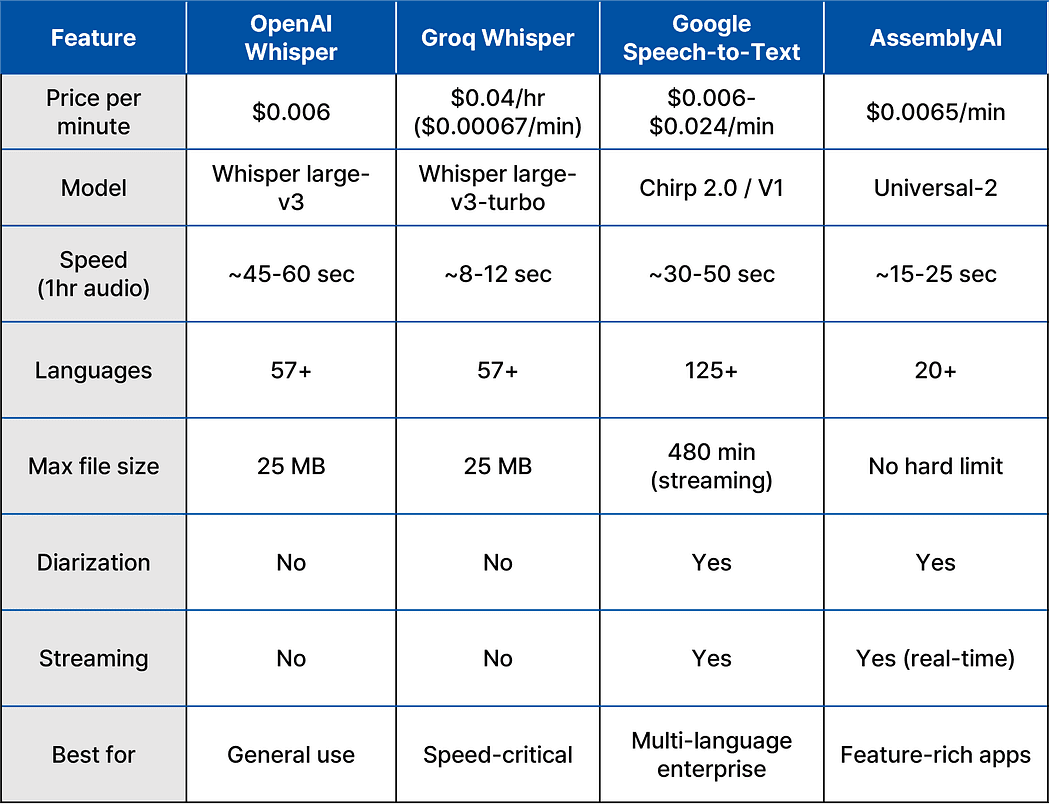
Even assuming just 2 minutes of daily voice recognition usage, that’s roughly $4.4 per vehicle per year, or $525K annually across 120,000 vehicles. And that’s just STT. Add LLM costs for understanding and generating responses, plus TTS for converting those responses back to speech, and the numbers grow substantially — compounding further as the cumulative fleet grows year over year.
4. Privacy concerns around in-cabin voice data
Conversations inside a vehicle are deeply personal. Transmitting and storing that data on external servers raises legitimate privacy concerns for drivers and creates compliance burdens around data regulation. On-device processing, where data never leaves the vehicle, is the most direct answer to this problem.
Given how clear the advantages of on-device voice AI are, leading players are already moving in this direction — either through internal development or partnerships with specialized voice AI companies. Mercedes-Benz is working with Liquid AI to embed a voice AI agent capable of handling speech recognition and natural language processing entirely on-board, integrated into their proprietary MB.OS operating system (targeting H2 2026 production). Premium EV brand Lucid is partnering with SoundHound AI to develop a conversational AI agent that functions even offline.

Source: Mercedes-Benz
ENERZAi in Automotive
Automotive application processors (APs) used in digital cockpits typically include both a GPU and NPU, and compared to consumer devices or wearables, they offer relatively generous memory and compute resources. Even so, running a full voice AI agent that supports natural, multi-turn conversation entirely on-device is a genuinely hard problem since more sophisticated speech recognition and language models demand proportionally more memory and compute.
Our Goal
ENERZAi’s vision goes beyond a voice assistant that simply executes commands. Ultimately, we’re building toward agentic AI , systems that don’t just recognize what a driver says, but understand the context, sustain multi-turn conversations, and autonomously decide which functions to invoke based on the situation. We’re especially focused on delivering this level of capability within the constrained memory and compute budgets of on-device automotive environments.
Ultra-Lightweight Voice and Language Models Optimized for the Target Domain
A great AI agent is only as good as the components that make it up. ENERZAi develops every module in the pipeline in-house, from Keyword Spotting (KWS) and Voice Activity Detection (VAD) to Speech-to-Text (STT), small Language Models (sLM), and Text-to-Speech (TTS). Since we design and train each module ourselves, we can tune the entire pipeline to fit both the automotive environment and each customer’s specific requirements.
And these models are purpose-built for on-device deployment, which means that we aim to maximize their performance within the target domain. Covering every possible topic would be nice. But what matters more is that the system works more accurately and faster on utterances within the target domain.

Source: Mihup
Hardware-Aware Optimization
The key to on-device AI is squeezing the best possible performance out of the available hardware, achieving high accuracy with minimum memory and power. ENERZAi compresses AI models to extremely low bit and transforms the underlying operations into forms that run optimally on the target hardware, delivering ultra-lightweight voice and language AI solutions tuned to each customer’s device environment. For operations not supported by semiconductor vendor SDKs, we build custom kernels (low-level execution code that defines how the hardware actually performs each computation), maximizing inference performance on whatever hardware the customer is running.
Until now, our primary deployment target has been Arm CPU-based SoCs, where we hold a strong advantage in terms of broad compatibility. Starting this year, however, we are progressively expanding support to GPUs and NPUs. We’ve already demonstrated this: by building custom kernels for operations unsupported by Qualcomm’s QNN, we successfully ran a 2B LLM on the Qualcomm Hexagon NPU (in the QCS6490). In other words, we now have the capability to efficiently leverage the full range of embedded CPU, GPU, and NPU resources found in automotive AP modules.
Running BitNet on Qualcomm Hexagon with custom 1.58 kernels
The voice control solutions we currently supply to customers span a full pipeline (keyword spotting, speech recognition, command execution, and speech synthesis) across multiple models. Yet the total RAM footprint stays under 500MB. That kind of memory efficiency means more headroom for other features, or the flexibility to run larger models on the same hardware.
On-Device AI in Automotive Is Inevitable
A car is no longer just a vehicle. It’s increasingly a computing platform running complex software across dozens of processors. And at the center of the user experience revolution sits the AI agent. Cloud-based AI can deliver strong performance, but when you factor in operational costs, network reliability, and data privacy, the move to on-device AI is not a question of if, but when.
Making that shift real, building AI agents capable of transforming the driving experience without depending on external infrastructure, requires AI compression and optimization technology capable of overcoming the memory bottlenecks of on-device environments. ENERZAi is committed to accelerating on-device AI adoption across the automotive industry with ultra-lightweight AI agents built specifically for the in-vehicle environment.
If you’re a vehicle OEM, digital cockpit manufacturer, or Tier 1 supplier exploring voice AI for edge, or if you’d simply like to learn more about ENERZAi’s technology and solutions, feel free to reach out through our website anytime!
Sungmin Woo, ENERZAi