
Articles

Top Python libraries of 2025

This article was originally published at Tryolabs’ website. It is reprinted here with the permission of Tryolabs. Welcome to the 11th edition of our yearly roundup of the Python libraries! If 2025 felt like the year of Large Language Models (LLMs) and agents, it’s because it truly was. The ecosystem expanded at incredible speed, with new models, […]

Top Python libraries of 2025 Read More +

How to Enhance 3D Gaussian Reconstruction Quality for Simulation

This article was originally published at NVIDIA’s website. It is reprinted here with the permission of NVIDIA. Building truly photorealistic 3D environments for simulation is challenging. Even with advanced neural reconstruction methods such as 3D Gaussian Splatting (3DGS) and 3D Gaussian with Unscented Transform (3DGUT), rendered views can still contain artifacts such as blurriness, holes, or

How to Enhance 3D Gaussian Reconstruction Quality for Simulation Read More +

Deep Learning Vision Systems for Industrial Image Processing

This blog post was originally published at Basler’s website. It is reprinted here with the permission of Basler. Deep learning vision systems are often already a central component of industrial image processing. They enable precise error detection, intelligent quality control, and automated decisions – wherever conventional image processing methods reach their limits. We show how a

Deep Learning Vision Systems for Industrial Image Processing Read More +

When DRAM Becomes the Bottleneck (Again): What the 2026 Memory Squeeze Means for Edge AI

A funny thing is happening in the edge AI world: some of the most important product decisions you’ll make this year won’t be about TOPS, sensor resolution, or which transformer variant to deploy. They’ll be about memory—how much you can get, how much it costs, and whether you can ship the exact part you designed

When DRAM Becomes the Bottleneck (Again): What the 2026 Memory Squeeze Means for Edge AI Read More +

Top 3 system patterns Gemini 3 Pro Vision unlocks for edge teams

For those who missed it in the holiday haze, Google’s Gemini 3 Pro launched on December 5th, but the push on vision isn’t just “better VQA.” Google frames it as a jump from recognition to visual + spatial reasoning, spanning documents, spatial, screens, and video. If you’re building edge AI products, that matters less as

Top 3 system patterns Gemini 3 Pro Vision unlocks for edge teams Read More +

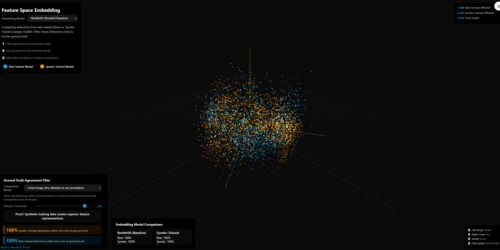
Better Than Real? What an Apple-Orchard Benchmark Really Says About Synthetic Data for Vision AI

If you work on edge AI or computer vision, you’ve probably run into the same wall over and over: The model architecture is fine. The deployment hardware is (barely) ok. But the data is killing you—too narrow, too noisy, too expensive to expand. That’s true whether you’re counting apples, spotting defects on a production line,

Better Than Real? What an Apple-Orchard Benchmark Really Says About Synthetic Data for Vision AI Read More +

What is a dust denoising filter in TOF camera, and how does it remove noise artifacts in vision systems?

This article was originally published at e-con Systems’ website. It is reprinted here with the permission of e-con Systems. Time-of-Flight (ToF) cameras with IR sensors are susceptible to performance variations caused by environmental dust. This dust can create ‘dust noise’ in the output depth map, directly impacting camera accuracy and, consequently, the reliability of critical

What is a dust denoising filter in TOF camera, and how does it remove noise artifacts in vision systems? Read More +

NVIDIA-Accelerated Mistral 3 Open Models Deliver Efficiency, Accuracy at Any Scale

This blog post was originally published at NVIDIA’s website. It is reprinted here with the permission of NVIDIA. The new Mistral 3 open model family delivers industry-leading accuracy, efficiency, and customization capabilities for developers and enterprises. Optimized from NVIDIA GB200 NVL72 to edge platforms, Mistral 3 includes: One large state-of-the-art sparse multimodal and multilingual mixture of

NVIDIA-Accelerated Mistral 3 Open Models Deliver Efficiency, Accuracy at Any Scale Read More +

SAM3: A New Era for Open‑Vocabulary Segmentation and Edge AI

Quality training data – especially segmented visual data – is a cornerstone of building robust vision models. Meta’s recently announced Segment Anything Model 3 (SAM3) arrives as a potential game-changer in this domain. SAM3 is a unified model that can detect, segment, and even track objects in images and videos using both text and visual

SAM3: A New Era for Open‑Vocabulary Segmentation and Edge AI Read More +

Optimizing LLMs for Performance and Accuracy with Post-training Quantization

This article was originally published at NVIDIA’s website. It is reprinted here with the permission of NVIDIA. Quantization is a core tool for developers aiming to improve inference performance with minimal overhead. It delivers significant gains in latency, throughput, and memory efficiency by reducing model precision in a controlled way—without requiring retraining. Today, most models

Optimizing LLMs for Performance and Accuracy with Post-training Quantization Read More +

Here you’ll find a wealth of practical technical insights and expert advice to help you bring AI and visual intelligence into your products without flying blind.

Contact

Address

Berkeley Design Technology, Inc.
PO Box #4446
Walnut Creek, CA 94596

Phone
Phone: +1 (925) 954-1411
Scroll to Top