
LLMs

Intel Releases OpenVINO 2026.3 with Expanded Generative AI and Model Support

Intel has released OpenVINO 2026.3, updating its open-source AI inference toolkit with broader model support, new generative AI pipelines, memory-efficiency improvements and expanded hardware compatibility. The release adds support for SmolLM3-3B, LFM2-1.2B and LFM2.5-1.2B across Intel CPUs, GPUs and NPUs. Additional models supported on CPUs and GPUs include Harrier OSS-v1-0.6B, Qwen3-8B with EAGLE-3, MiniCPM5-1B and […]

Intel Releases OpenVINO 2026.3 with Expanded Generative AI and Model Support Read More +

Why Vision LLMs Force A Rethink Of Edge AI Hardware

This blog post was originally published at Expedera’s website. It is reprinted here with the permission of Expedera. As vision-centric large language models move on-device, performance measured in raw TOPS is no longer enough. Architectures need to be built around real workloads, memory behavior, and sustained utilization, especially at the edge. Vision LLMs are changing

Why Vision LLMs Force A Rethink Of Edge AI Hardware Read More +

Gemma 4 on Arm: Accessible, Immediate, Optimized On-device AI to Accelerate the Mobile App Experience

Gemma 4 on Arm brings fast, privacy-preserving, power-efficient AI directly onto Android devices, helping developers deliver richer real-time app experiences to billions of users without relying on the cloud.   This blog post was originally published at Arm’s website. It is reprinted here with the permission of Arm. Real-time assistance, seamless communication, and greater personalization are now baseline expectations for billions of smartphone

Gemma 4 on Arm: Accessible, Immediate, Optimized On-device AI to Accelerate the Mobile App Experience Read More +

Bringing AI Closer to the Edge and On-Device with Gemma 4

This blog post was originally published at NVIDIA’s website. It is reprinted here with the permission of NVIDIA. The Gemmaverse expands with the launch of the latest Gemma 4 multimodal and multilingual models, designed to scale across the full spectrum of deployments, from NVIDIA Blackwell in the data center to Jetson at the edge. These models are suited

Bringing AI Closer to the Edge and On-Device with Gemma 4 Read More +

Google Pushes Multimodal AI Further Onto Edge Devices with Gemma 4

MOUNTAIN VIEW, Calif., April 2, 2026 — Google has introduced Gemma 4, a new family of open models with open weights that is clearly aimed at bringing more capable AI onto local hardware. Released under the Apache 2.0 license, the Gemma 4 family includes four sizes: E2B, E4B, 26B A4B MoE and 31B Dense. Google

Google Pushes Multimodal AI Further Onto Edge Devices with Gemma 4 Read More +

Gemma 4 Models Optimized for Intel Hardware: Enabling Instant Deployment from Day Zero

We’re excited to announce Intel’s strategic partnership with Google to deliver optimized Gemma 4 models on Intel hardware from day one. This collaboration enables developers to leverage the power of Google’s latest AI models on Intel hardware: Intel® Core™ Ultra processors, Intel® Xeon® CPUs, and Intel® Arc™ GPUs. Developers can create AI applications that run

Gemma 4 Models Optimized for Intel Hardware: Enabling Instant Deployment from Day Zero Read More +

From hardware to intelligence: The Qualcomm AI camera platform for scalable security solutions

At ISC West 2026 Qualcomm Technologies showcases its vision for the future of smart camera and security Key Takeaways: End-to-end AI development tools and the Qualcomm Insight Platform to enable customers to develop AI features once and scale across their entire product portfolio. Qualcomm Technologies’ camera solutions span video security, law enforcement and enterprise body

From hardware to intelligence: The Qualcomm AI camera platform for scalable security solutions Read More +

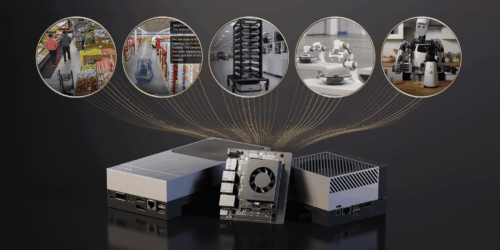
Getting Started with Edge AI on NVIDIA Jetson: LLMs, VLMs, and Foundation Models for Robotics

This article was originally published at NVIDIA’s website. It is reprinted here with the permission of NVIDIA. Running advanced AI and computer vision workloads on small, power-efficient devices at the edge is a growing challenge. Robots, smart cameras, and autonomous machines need real-time intelligence to see, understand, and react without depending on the cloud. The NVIDIA

Getting Started with Edge AI on NVIDIA Jetson: LLMs, VLMs, and Foundation Models for Robotics Read More +

AI On: 3 Ways to Bring Agentic AI to Computer Vision Applications

This blog post was originally published at NVIDIA’s website. It is reprinted here with the permission of NVIDIA. Learn how to integrate vision language models into video analytics applications, from AI-powered search to fully automated video analysis. Today’s computer vision systems excel at identifying what happens in physical spaces and processes, but lack the abilities to explain the

AI On: 3 Ways to Bring Agentic AI to Computer Vision Applications Read More +

NVIDIA-Accelerated Mistral 3 Open Models Deliver Efficiency, Accuracy at Any Scale

This blog post was originally published at NVIDIA’s website. It is reprinted here with the permission of NVIDIA. The new Mistral 3 open model family delivers industry-leading accuracy, efficiency, and customization capabilities for developers and enterprises. Optimized from NVIDIA GB200 NVL72 to edge platforms, Mistral 3 includes: One large state-of-the-art sparse multimodal and multilingual mixture of

NVIDIA-Accelerated Mistral 3 Open Models Deliver Efficiency, Accuracy at Any Scale Read More +

Here you’ll find a wealth of practical technical insights and expert advice to help you bring AI and visual intelligence into your products without flying blind.

Contact

Address

Berkeley Design Technology, Inc.
PO Box #4446
Walnut Creek, CA 94596

Phone
Phone: +1 (925) 954-1411
Scroll to Top