Algorithms & Models

A Practical Guide to Recall, Precision, and NDCG

This blog post was originally published at Rapidflare’s website. It is reprinted here with the permission of Rapidflare. Introduction Retrieval-Augmented Generation (RAG) is revolutionizing how Large Language Models (LLMs) access and use information. By grounding models in domain specific data from authoritative sources, RAG systems deliver more accurate and context-aware answers. But a RAG system is […]

A Practical Guide to Recall, Precision, and NDCG Read More +

Google Adds “Agentic Vision” to Gemini 3 Flash

Jan. 30, 2026 — Google has announced Agentic Vision, a new capability in Gemini 3 Flash that turns image understanding into an active, tool-using workflow rather than a single “static glance.” Agentic Vision pairs visual reasoning with code execution (Python) so the model can iteratively zoom in, crop, annotate, and otherwise manipulate an image to

Google Adds “Agentic Vision” to Gemini 3 Flash Read More +

Robotics Builders Forum offers Hardware, Know-How and Networking to Developers

On February 25, 2026 from 8:30 am to 5:30 pm ET, Advantech, Qualcomm, Arrow, in partnership with D3 Embedded, Edge Impulse, and the Pittsburgh Robotics Network will present Robotics Builders Forum, an in-person conference for engineers and product teams. Qualcomm and D3 Embedded are members of the Edge AI and Vision Alliance, while Edge Impulse

Robotics Builders Forum offers Hardware, Know-How and Networking to Developers Read More +

On-Device LLMs in 2026: What Changed, What Matters, What’s Next

In On-Device LLMs: State of the Union, 2026, Vikas Chandra and Raghuraman Krishnamoorthi explain why running LLMs on phones has moved from novelty to practical engineering, and why the biggest breakthroughs came not from faster chips but from rethinking how models are built, trained, compressed, and deployed. Why run LLMs locally? Four reasons: latency (cloud

On-Device LLMs in 2026: What Changed, What Matters, What’s Next Read More +

Getting Started with Edge AI on NVIDIA Jetson: LLMs, VLMs, and Foundation Models for Robotics

This article was originally published at NVIDIA’s website. It is reprinted here with the permission of NVIDIA. Running advanced AI and computer vision workloads on small, power-efficient devices at the edge is a growing challenge. Robots, smart cameras, and autonomous machines need real-time intelligence to see, understand, and react without depending on the cloud. The NVIDIA

Getting Started with Edge AI on NVIDIA Jetson: LLMs, VLMs, and Foundation Models for Robotics Read More +

Top Python Libraries of 2025

This article was originally published at Tryolabs’ website. It is reprinted here with the permission of Tryolabs. Welcome to the 11th edition of our yearly roundup of the Python libraries! If 2025 felt like the year of Large Language Models (LLMs) and agents, it’s because it truly was. The ecosystem expanded at incredible speed, with new models,

Top Python Libraries of 2025 Read More +

How to Enhance 3D Gaussian Reconstruction Quality for Simulation

This article was originally published at NVIDIA’s website. It is reprinted here with the permission of NVIDIA. Building truly photorealistic 3D environments for simulation is challenging. Even with advanced neural reconstruction methods such as 3D Gaussian Splatting (3DGS) and 3D Gaussian with Unscented Transform (3DGUT), rendered views can still contain artifacts such as blurriness, holes, or

How to Enhance 3D Gaussian Reconstruction Quality for Simulation Read More +

Deep Learning Vision Systems for Industrial Image Processing

This blog post was originally published at Basler’s website. It is reprinted here with the permission of Basler. Deep learning vision systems are often already a central component of industrial image processing. They enable precise error detection, intelligent quality control, and automated decisions – wherever conventional image processing methods reach their limits. We show how a

Deep Learning Vision Systems for Industrial Image Processing Read More +

NVIDIA Unveils New Open Models, Data and Tools to Advance AI Across Every Industry

This post was originally published at NVIDIA’s website. It is reprinted here with the permission of NVIDIA. Expanding the open model universe, NVIDIA today released new open models, data and tools to advance AI across every industry. These models — spanning the NVIDIA Nemotron family for agentic AI, the NVIDIA Cosmos platform for physical AI, the new NVIDIA Alpamayo family for autonomous vehicle

NVIDIA Unveils New Open Models, Data and Tools to Advance AI Across Every Industry Read More +

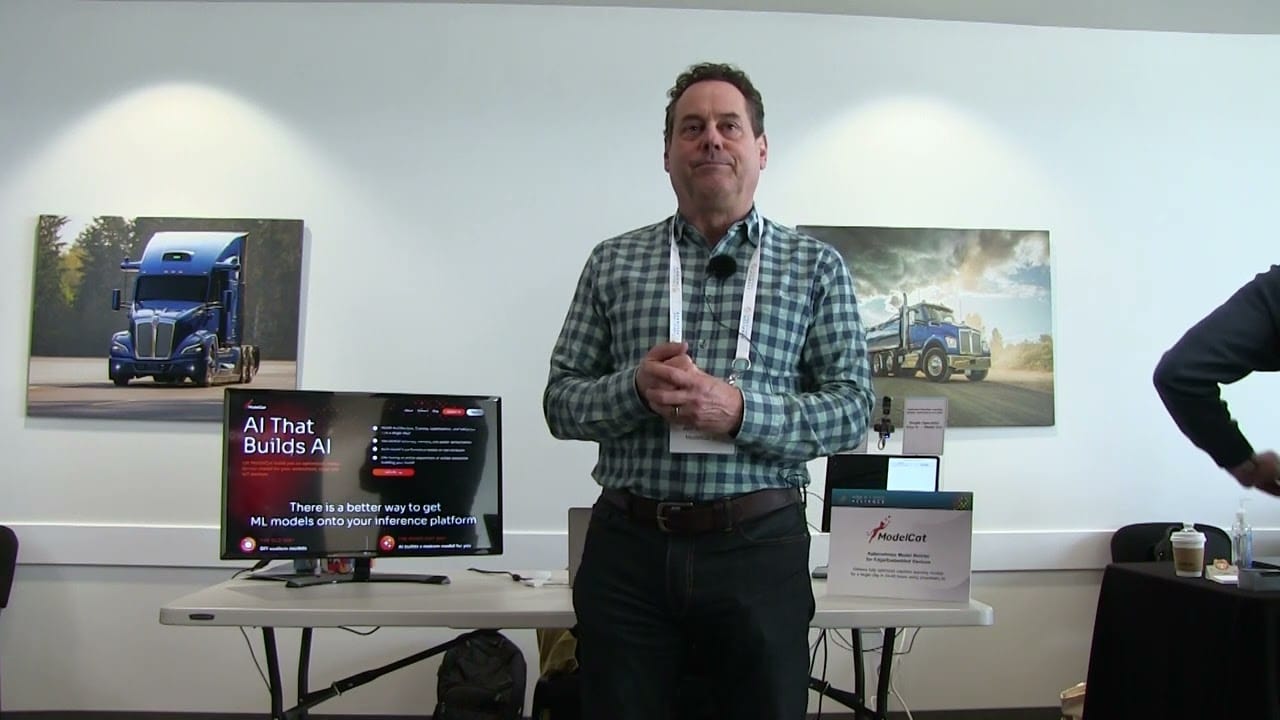
ModelCat AI Partners with Alif Semiconductor to Deliver Rapid ML Model Onboarding to Customers

The partnership slashes model onboarding time to under 30 days, offering Alif customers a “Cursor-like” experience for building and deploying Edge AI models.   SUNNYVALE, Calif., Jan. 6, 2026 (PRNewswire) — ModelCat AI, the creator of the world’s first fully autonomous AI model builder, today announced a strategic partnership with Alif Semiconductor, a global leader in

ModelCat AI Partners with Alif Semiconductor to Deliver Rapid ML Model Onboarding to Customers Read More +

Here you’ll find a wealth of practical technical insights and expert advice to help you bring AI and visual intelligence into your products without flying blind.

Contact

Address

Berkeley Design Technology, Inc.
PO Box #4446
Walnut Creek, CA 94596

Phone
Phone: +1 (925) 954-1411
Scroll to Top