
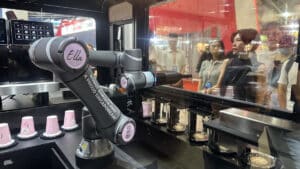
Intel Core Ultra Series 3: The New Standard for Edge AI Robotics Compute
By integrating a CPU, GPU, and NPU, Intel Core Ultra Series 3 delivers edge AI power across global use cases—from hospitality and manufacturing to healthcare and education. At 2 a.m., an emergency room nurse orders a latte at a quiet hospital coffee stand. There is no human behind the counter. Instead, a sleek robotic arm
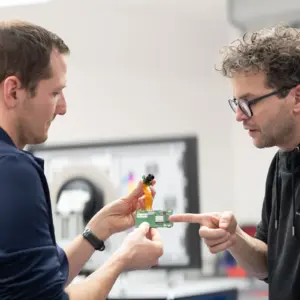
How Customized Single-board Computers Increase the Profitability of Embedded Vision Systems
This blog post was originally published at Helbling’s website. It is reprinted here with the permission of Helbling. Artificial Intelligence is one of the defining technological trends of this decade. In particular, vision-based AI applications, where camera data is processed directly on the edge, are gaining rapid momentum. Embedded Vision systems are the backbone of these
AMD Silo AI and University of Bologna Start Spatial AI Collaboration for Robotics and Autonomous Driving
The research collaboration will focus on building geometry-aware perception modules on the AMD ROCm™ open software stack AMD Silo AI and University of Bologna through its Department of Computer Science and Engineering (DISI) are starting a research collaboration to bring explicit 3D geometry into the Vision Language Action (VLA) and world-model pipeline for robotics and
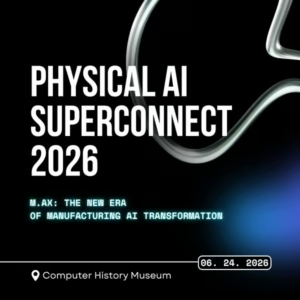
Upcoming Event on AI Transformation
KOTRA Silicon Valley will host “Physical AI Superconnect 2026,” on June 24, 2026, from 10:00 am to 8:00 pm PDT at the Computer History Museum in Mountain View, California. The event will feature insightful presentations, technology exhibits, matchmaking and networking. From the event page: M.AX: A New Era of Manufacturing AI Transformation Physical AI Superconnect

Physical AI: 8 Questions Every Engineering Leader Is Asking
This blog post was originally published at Geisel Software’s website. It is reprinted here with the permission of Geisel Software. Jensen Huang called it at CES 2025: “The next frontier of AI is physical.” Since then, the phrase has been everywhere — in investor decks, conference keynotes, and vendor pitches. But for the software engineering managers, directors, VPs, and

Everything Is Going to Be Driven by Algorithms
This blog post was originally published at Ambarella’s website. It is reprinted here with the permission of Ambarella. A security camera on a warehouse loading dock captures 86,400 seconds of video every day. A fleet telematics recorder on a long-haul truck accumulates gigabytes of road footage between fuel stops. A surgical robot’s stereo cameras generate
The rise of smarter robots and why memory is becoming their superpower
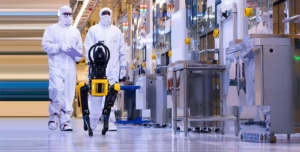
This blog post was originally published at Micron Technology’s website. It is reprinted here with the permission of Micron Technology. If it feels like robots are evolving faster than ever, that’s because they are. We’re watching an industry shift in real time, from factory floors to warehouses to emerging humanoid systems, all powered by advances in
Physical AI: From ST Sensors to a Robotics Platform, How Innovation Can Only Happen Through Collaboration
This blog post was originally published at STMicroelectronics’s website. It is reprinted here with the permission of STMicroelectronics. As technology aims to enable Physical AI, ST is sharing today how collaboration brought our sensors into a Holoscan Sensor Bridge module from Leopard Imaging, enabling developers to feed multi-modal sensing data to the NVIDIA Jetson Thor or
Texas Instruments, D3 Embedded, Lattice and NVIDIA Show a Practical Radar-Camera Fusion Stack for Robotics
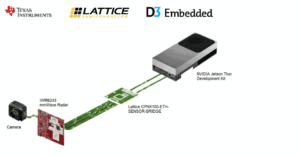
TI’s new application brief and companion demo outline how mmWave radar, camera input, FPGA-based sensor bridging and NVIDIA Holoscan can be combined into a low-latency perception pipeline for humanoids and other autonomous machines. Texas Instruments, D3 Embedded, Lattice Semiconductor and NVIDIA are outlining a concrete radar-camera fusion stack for robotics rather than just talking

Building Robotics Applications with Ryzen AI and ROS 2
This blog post was originally published at AMD’s website. It is reprinted here with the permission of AMD. This blog showcases how to deploy power-efficient Ryzen AI perception models with ROS 2 – the Robot Operating System. We utilize the Ryzen AI Max+ 395 (Strix-Halo) platform, which is equipped with an efficient Ryzen AI NPU and
Humanoid Robots 2026-2036: Technologies, Markets, and Opportunities
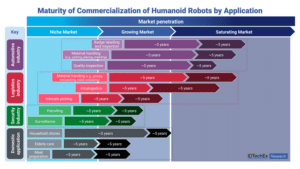
Maturity of commercialization of humanoid robotics by application. For full data, refer to IDTechEx’s research on “Humanoid Robots 2026-2036: Technology, Market, and Opportunities” This blog post was originally published at IDTechEx’s website. It is reprinted here with the permission of IDTechEx. Automotive industry, logistics, home-use, key players and suppliers, AI chip, battery, actuator, motor, screw, tactile

2026: The Year Intelligence Gets Physical
This article was originally published at Analog Devices’ website. It is reprinted here with the permission of Analog Devices. Artificial intelligence is entering a new phase where models interpret contextual data whilst interacting with the physical world in real time. At Analog Devices, Inc. (ADI), we call this Physical Intelligence: intelligent systems that can perceive, reason

STMicroelectronics and Leopard Imaging Accelerate Robotics Vision with NVIDIA Jetson-ready Multi-sensor Module
Key Takeaways Multimodal module combining 2D imaging, 3D depth sensing, and human-like motion perception NVIDIA Holoscan Sensor Bridge ensuring multi-gigabit plug and play connectivity with Jetson platforms Fully supported by NVIDIA Isaac open robot development platform STMicroelectronics and Leopard Imaging® have introduced an all-in-one multimodal vision module for humanoid and other advanced robotics systems. Combining

Lattice Joins NVIDIA Halos Ecosystem to Advance Safety for Physical AI with Holoscan Sensor Bridge
HILLSBORO, Ore. – Mar. 16, 2026 – Lattice Semiconductor (NASDAQ: LSCC), the low power programmable leader, today announced it has joined the NVIDIA Halos AI Systems Inspection Lab ecosystem, the first ANSI National Accreditation Board (ANAB) accredited inspection lab for AI-driven physical systems. Announced at the NVIDIA GTC 2026, Lattice will engage with NVIDIA and other Halos ecosystem members to
NVIDIA and Global Robotics Leaders Take Physical AI to the Real World
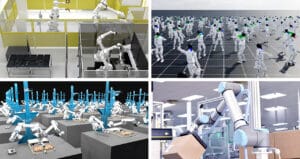
News Summary: Physical AI leaders across robot brain developers, industrial, and surgical robot giants and humanoid pioneers including ABB Robotics, AGIBOT, Agility, CMR Surgical, FANUC, Figure, Hexagon Robotics, KUKA, Medtronic, Skild AI, Universal Robots, World Labs and YASKAWA are building on NVIDIA technology to develop and deploy physical AI at scale. NVIDIA unveils new NVIDIA

NXP Delivers New Innovations for Advanced Physical AI with NVIDIA
Key Takeaways: Secure, reliable real-time data processing and transport solutions for next-generation physical AI applications, developed in collaboration with NVIDIA NVIDIA humanoid robotics solutions integrated into NXP’s safe, secure edge portfolio cut development costs and speed time to market First in a series of NXP’s foundational robotics solutions designed to accelerate physical AI development and
Arduino Announces Arduino VENTUNO Q, Powered by Qualcomm Dragonwing IQ8 Series
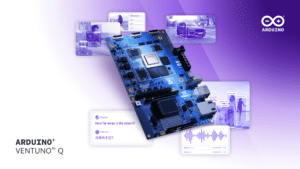
The new platform by the leading open-source hardware provider is purpose-built for generative AI, robotics, and actuation — making advanced capabilities accessible to all. Ahead of Embedded World, Arduino announced the upcoming launch of its newest platform to democratize edge AI, Arduino® VENTUNO™ Q. Named after the Italian word for twenty-one, VENTUNO Q builds on the iconic
Conversations at the Edge with NXP
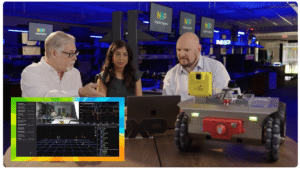
This blog post was originally published at Au-Zone’s website. It is reprinted here with the permission of Au-Zone. Are Single-Sensor Robots Obsolete? We think so, and we’re here to show you why. Au-Zone is proud to be featured in NXP Semiconductors’ Conversations at the Edge video series, a multi-part collaboration exploring innovation at the intersection of