PROVIDER

Accelerating AI-Defined Cars

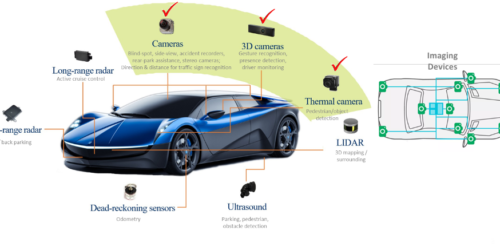
Convergence of Edge Computing, Machine Vision and 5G-Connected Vehicles Today’s societies are becoming ever more multimedia-centric, data-dependent, and automated. Autonomous systems are hitting our roads, oceans, and air space. Automation, analysis, and intelligence is moving beyond humans to “machine-specific” applications. Computer vision and video for machines will play a significant role in our future digital […]

Accelerating AI-Defined Cars Read More +
1200px-Khronos_Group_SYCL_logo_600

Khronos Releases SYCL 2020 Specification

Major update includes dozens of new features and closer alignment with ISO C++. Significant SYCL adoption in embedded, desktop, and HPC markets. Beaverton, OR – February 9, 2021 – Today, The Khronos® Group, an open consortium of industry-leading companies creating advanced interoperability standards, announces the ratification and public release of the SYCL™ 2020 final specification—the

Khronos Releases SYCL 2020 Specification Read More +

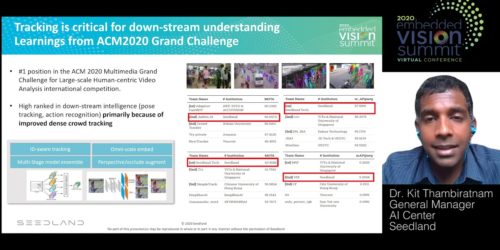
“Multi-modal Re-identification: IOT + Computer Vision for Residential Community Tracking,” a Presentation from Seedland

Kit Thambiratnam, General Manager of the Seedland AI Center, presents the “Multi-modal Re-identification: IOT + Computer Vision for Residential Community Tracking” tutorial at the September 2020 Embedded Vision Summit. The recent COVID-19 outbreak necessitated monitoring in communities such as tracking of quarantined residents and tracking of close-contact interactions with sick individuals. High-density communities also have

“Multi-modal Re-identification: IOT + Computer Vision for Residential Community Tracking,” a Presentation from Seedland Read More +

The Rise and Fall of the ADAS Promise Now Disrupted by AVs

This market research report was originally published at Yole Développement’s website. It is reprinted here with the permission of Yole Développement. Advanced driver assistance systems (ADAS) have been developed for more than ten years now, in pursuit of increased safety in the world of automobiles. Combining a set of sensors, mostly radars and cameras combined

The Rise and Fall of the ADAS Promise Now Disrupted by AVs Read More +

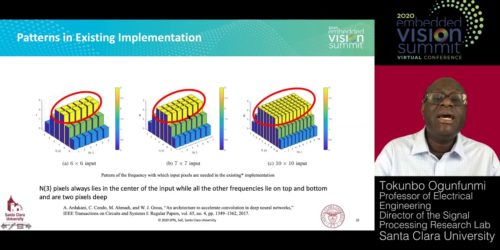
“New Methods for Implementation of 2-D Convolution for Convolutional Neural Networks,” a Presentation from Santa Clara University

Tokunbo Ogunfunmi, Professor of Electrical Engineering and Director of the Signal Processing Research Laboratory at Santa Clara University, presents the “New Methods for Implementation of 2-D Convolution for Convolutional Neural Networks” tutorial at the September 2020 Embedded Vision Summit. The increasing usage of convolutional neural networks (CNNs) in various applications on mobile and embedded devices

“New Methods for Implementation of 2-D Convolution for Convolutional Neural Networks,” a Presentation from Santa Clara University Read More +

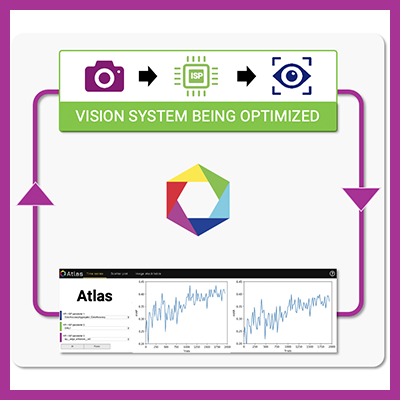
Free Webinar Explores Camera ISP Optimization For Improved Computer Vision Accuracy

On March 30, 2021 at 9 am PT (noon ET), Marc Courtemanche, Product Architect at Algolux, will present the free half-hour webinar “Optimizing a Camera ISP to Automatically Improve Computer Vision Accuracy,” organized by the Edge AI and Vision Alliance. Here’s the description, from the event registration page: Cameras are the most ubiquitous sensor used

Free Webinar Explores Camera ISP Optimization For Improved Computer Vision Accuracy Read More +

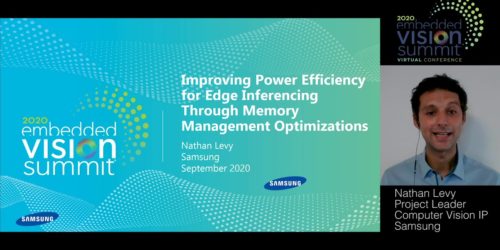
“Improving Power Efficiency for Edge Inferencing with Memory Management Optimizations,” a Presentation from Samsung

Nathan Levy, Project Leader at Samsung, presents the “Improving Power Efficiency for Edge Inferencing with Memory Management Optimizations” tutorial at the September 2020 Embedded Vision Summit. In the race to power efficiency for neural network processing, optimizing memory use to reduce data traffic is critical. Many processors have a small local memory (typically SRAM) used

“Improving Power Efficiency for Edge Inferencing with Memory Management Optimizations,” a Presentation from Samsung Read More +

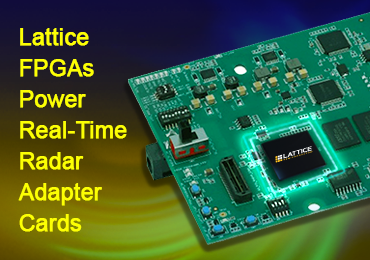
Lattice FPGAs Power Real-Time Radar Adapter Cards

This blog post was originally published at Lattice Semiconductor’s website. It is reprinted here with the permission of Lattice Semiconductor. If you were to ask them (and I have), you would discover that many people think of radar in the context of things like airplanes and ships and the evening weather forecast on TV. As

Lattice FPGAs Power Real-Time Radar Adapter Cards Read More +

“Image-Based Deep Learning for Manufacturing Fault Condition Detection,” a Presentation from Samsung

Jake Lee, Principal Engineer and Head of the Machine Learning Group at Samsung, presents the “Image-Based Deep Learning for Manufacturing Fault Condition Detection” tutorial at the September 2020 Embedded Vision Summit. In this presentation, Lee explores applying deep learning to analyzing manufacturing parameter data to detect fault conditions. The manufacturing parameter data contains multivariate time

“Image-Based Deep Learning for Manufacturing Fault Condition Detection,” a Presentation from Samsung Read More +

Here you’ll find a wealth of practical technical insights and expert advice to help you bring AI and visual intelligence into your products without flying blind.

Contact

Address

Berkeley Design Technology, Inc.
PO Box #4446
Walnut Creek, CA 94596

Phone
Phone: +1 (925) 954-1411
Scroll to Top