
PROVIDER

NVIDIA Alpamayo 2 Super, the Frontier Open Model for Robotaxis and Autonomous Vehicles, Now Available for Commercial Use

Open commercial licensing, benchmark‑leading reasoning and inspectable decisions bring autonomous vehicles, including robotaxis, closer to production and widescale deployment.   This news blog was originally published at NVIDIA’ website. It is reprinted here with the permission of NVIDIA.   For robotaxis and other autonomous vehicles (AVs), the hardest problems aren’t the everyday scenarios. They’re the rare, complex situations that

NVIDIA Alpamayo 2 Super, the Frontier Open Model for Robotaxis and Autonomous Vehicles, Now Available for Commercial Use Read More +

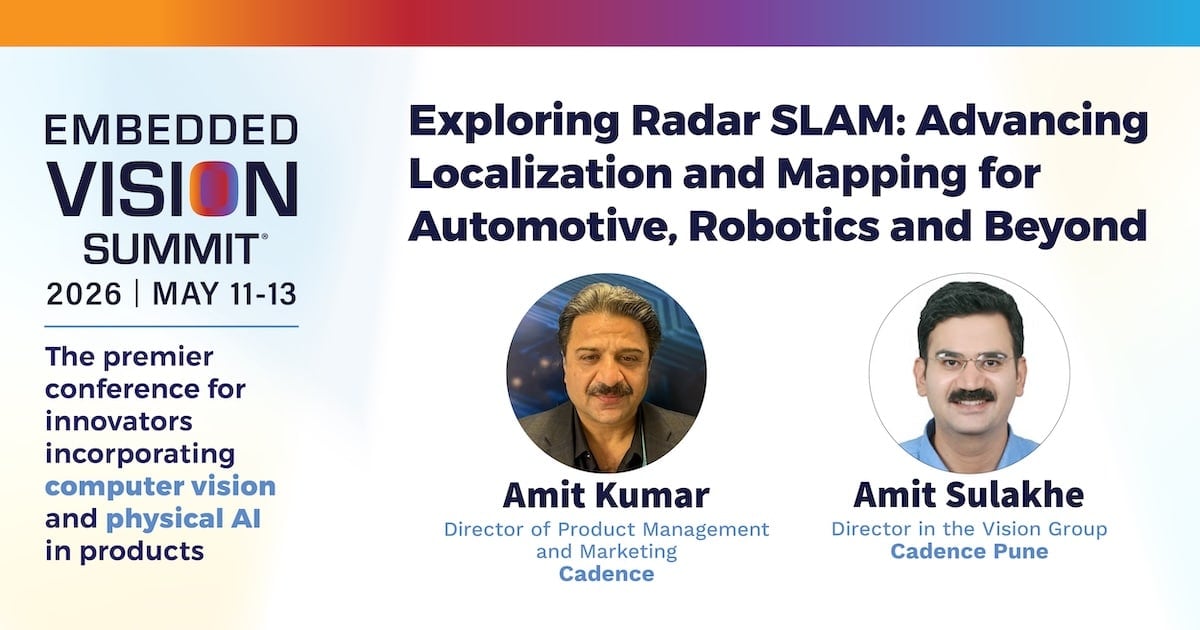
“Exploring Radar SLAM: Advancing Localization and Mapping for Automotive, Robotics and Beyond,” a Presentation from Cadence

Amit Kumar, Director of Product Management and Marketing at Cadence and Amit Sulakhe, Director in the Vision Group at Cadence Pune present “Exploring Radar SLAM: Advancing Localization and Mapping for Automotive, Robotics and Beyond” at the May 2026 Embedded Vision Summit. Reliable localization and mapping are foundational for autonomous vehicles… “Exploring Radar SLAM: Advancing Localization

“Exploring Radar SLAM: Advancing Localization and Mapping for Automotive, Robotics and Beyond,” a Presentation from Cadence Read More +

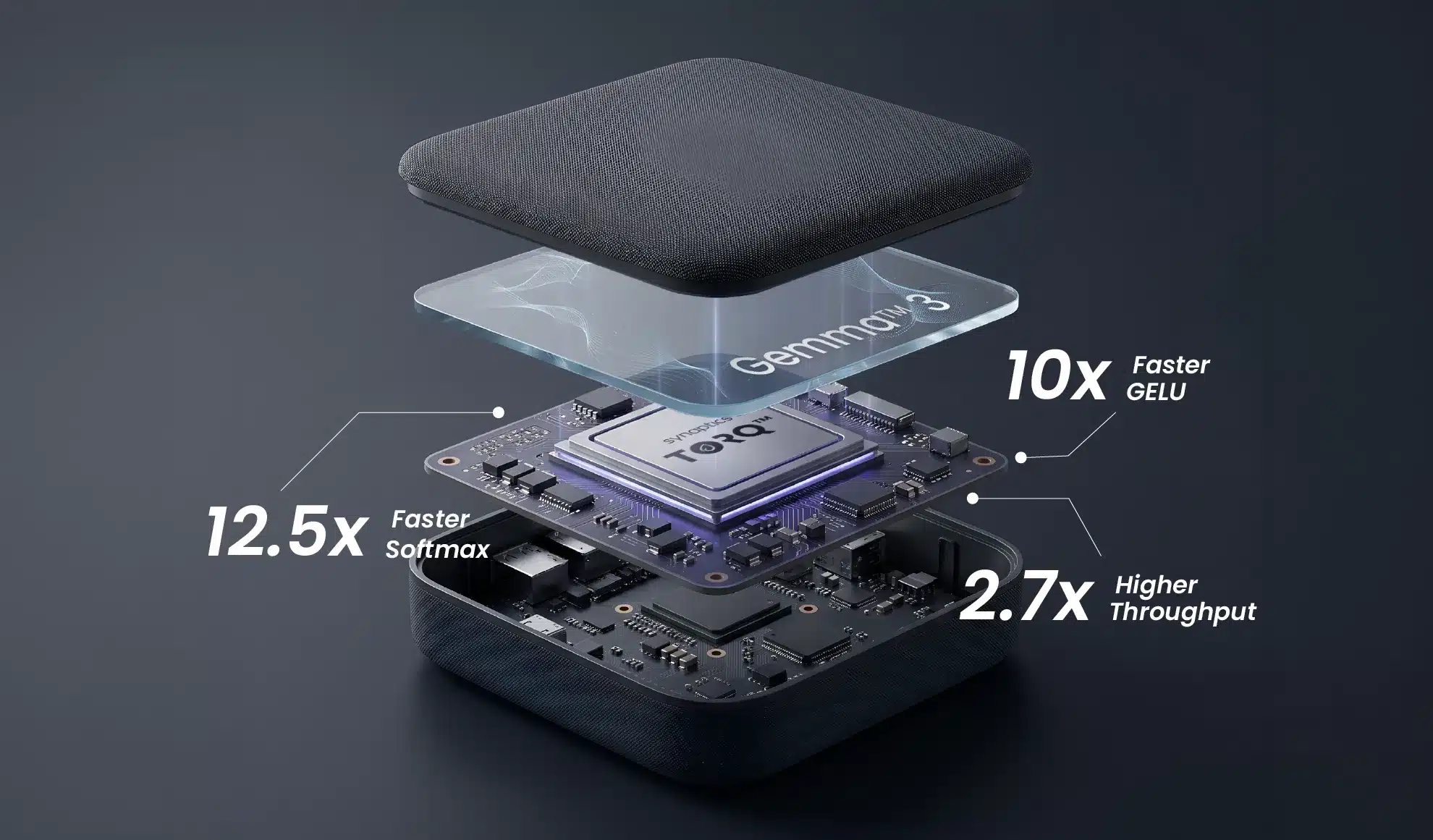
The Edge LLM Offload Story: How Synaptics Torq™ Enables High-Efficiency Gemma™ Inference

This blog post was originally published at Synaptics’ website. It is reprinted here with the permission of Synaptics. Developers and system architects today face a growing demand to enable large language model variants on device. They are facing pressure to support transformer-capable models on constrained devices to ensure data privacy, eliminate cloud API charges, and provide

The Edge LLM Offload Story: How Synaptics Torq™ Enables High-Efficiency Gemma™ Inference Read More +

Intel Releases OpenVINO 2026.3 with Expanded Generative AI and Model Support

Intel has released OpenVINO 2026.3, updating its open-source AI inference toolkit with broader model support, new generative AI pipelines, memory-efficiency improvements and expanded hardware compatibility. The release adds support for SmolLM3-3B, LFM2-1.2B and LFM2.5-1.2B across Intel CPUs, GPUs and NPUs. Additional models supported on CPUs and GPUs include Harrier OSS-v1-0.6B, Qwen3-8B with EAGLE-3, MiniCPM5-1B and

Intel Releases OpenVINO 2026.3 with Expanded Generative AI and Model Support Read More +

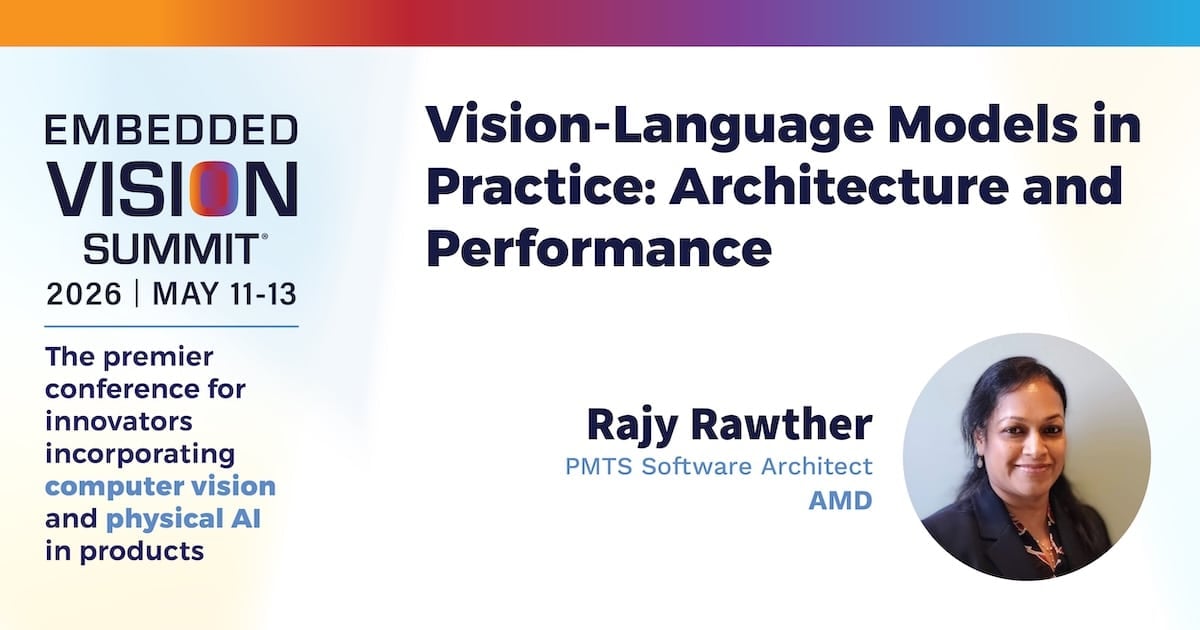
“Vision-Language Models in Practice: Architecture and Performance,” a Presentation from AMD

Rajy Rawther, PMTS Software Architect at AMD presents “Vision-Language Models in Practice: Architecture and Performance” at the May 2026 Embedded Vision Summit. Unimodal vision systems are powerful but limited when users need flexible queries, richer semantics or reasoning that combines images/video with language. Vision-language models (VLMs) address this gap by… “Vision-Language Models in Practice: Architecture

“Vision-Language Models in Practice: Architecture and Performance,” a Presentation from AMD Read More +

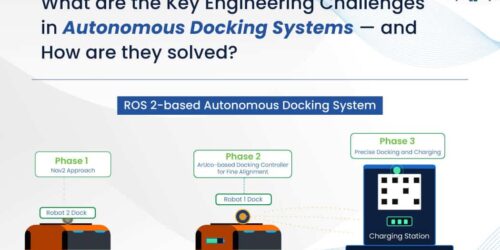
What are the Key Engineering Challenges in Autonomous Docking Systems and How are they Solved? (Part 2)

This blog post was originally published at e-con Systems’ website. It is reprinted here with the permission of e-con Systems. Designing an ROS 2-based autonomous docking system is only half the story. Deploying it in the real world is another matter entirely. Since real industrial environments don’t cooperate with textbook assumptions, understanding these challenges will help

What are the Key Engineering Challenges in Autonomous Docking Systems and How are they Solved? (Part 2) Read More +

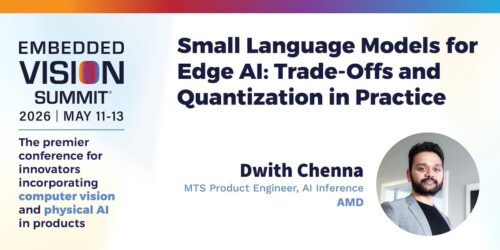
“Small Language Models for Edge AI: Trade-Offs and Quantization in Practice,” a Presentation from AMD

Dwith Chenna, MTS Product Engineer, AI Inference at AMD presents “Small Language Models for Edge AI: Trade-Offs and Quantization in Practice” at the May 2026 Embedded Vision Summit. Large language models are powerful but often impractical for embedded and on-prem systems due to latency, cost, privacy and memory constraints. Small… “Small Language Models for Edge

“Small Language Models for Edge AI: Trade-Offs and Quantization in Practice,” a Presentation from AMD Read More +

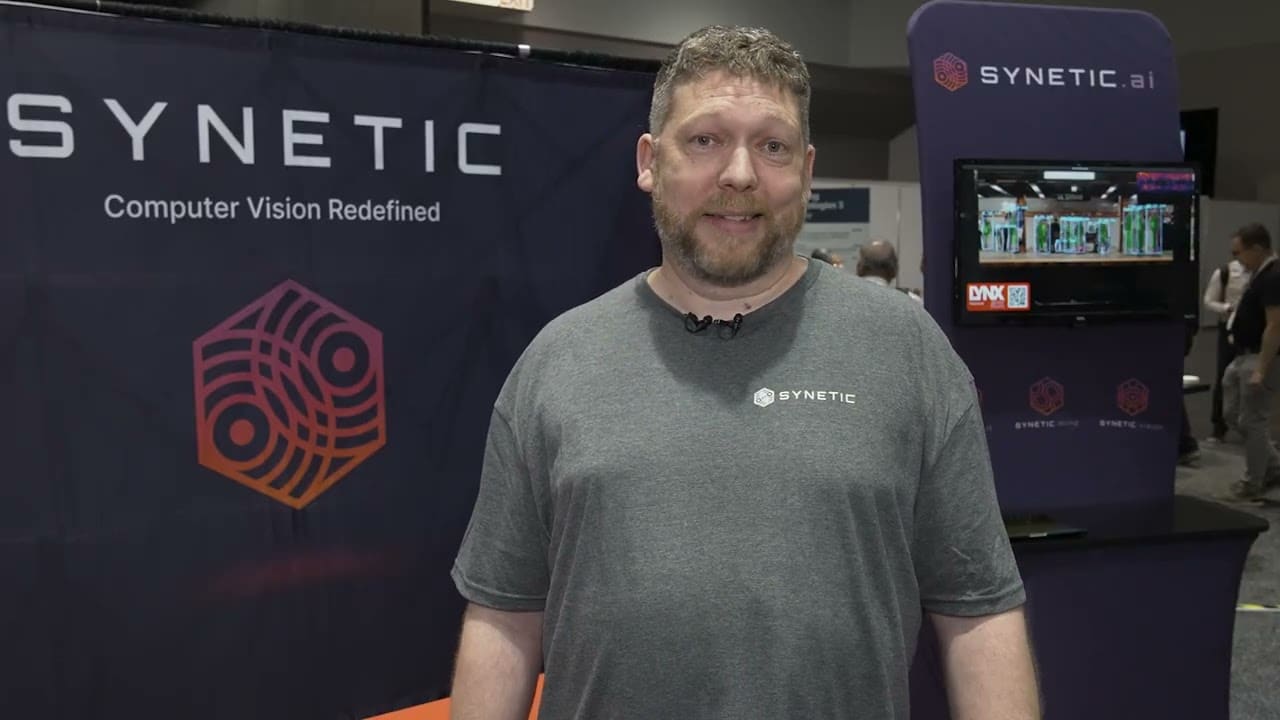
Synetic Demonstration of Synthetic Training Data for Computer Vision Edge Case Coverage

David Scott, CEO & Founder at Synetic, makes the case for synthetic training data as the most practical solution to edge case coverage in computer vision at the 2025 Embedded Vision Summit. Real-world data collection is slow, expensive, and structurally unable to capture the rare but critical scenarios — adverse lighting, unusual occlusions, extreme environments

Synetic Demonstration of Synthetic Training Data for Computer Vision Edge Case Coverage Read More +

Seeing the Invisible: How Advanced AFEs Give Robots True Self Awareness

This blog post was originally published at NXP Semiconductors’ website. It is reprinted here with the permission of NXP Semiconductors. If cameras, LiDAR and IMUs are a robot’s eyes and inner ear, then precision analog measurement is its “sense of self”, the quiet awareness of currents, strains and temperatures that tell you how the machine

Seeing the Invisible: How Advanced AFEs Give Robots True Self Awareness Read More +

Here you’ll find a wealth of practical technical insights and expert advice to help you bring AI and visual intelligence into your products without flying blind.

Contact

Address

Berkeley Design Technology, Inc.
PO Box #4446
Walnut Creek, CA 94596

Phone
Phone: +1 (925) 954-1411
Scroll to Top